.png)
.svg)


7 Best Consumer Insights Tools for Customer Research
Discover top 7 consumer insight tools, compared for features, ease of use, and data analysis power.



A few years ago, customer research teams mostly worried about collecting data.
Today, the bigger challenge is making sense of everything they've already collected. Because valuable insights end up scattered across half a dozen tools, making them difficult to find and even harder to reuse.
How can you make sure that good consumer research actually informs product decisions?
That's the problem consumer insights tools are trying to solve.
If you’re a UX researcher, product manager, or part of an insights team, we wrote this guide for you.
Let’s compare the strongest options currently available.

TL;DR: Best consumer insights tools
We’ve selected our top tools and ordered them according to specific needs.
The top consumer insight tools available today are:
- HeyMarvin for research repositories and insight management
- Google Analytics for website analytics
- Hotjar for understanding user behavior on web pages
- Medallia for enterprise customer experience management
- Google Trends for market research and content planning
- Qualtrics for customer and employee feedback programs
- Gong for sales and conversation intelligence
- Amplitude for product analytics
- FullStory for digital experience analysis
- Mixpanel for measuring product performance
Different tools help you collect and analyze different types of consumer insights, but HeyMarvin turns your research into a living knowledge system. Book a free demo to see this AI-native consumer insights platform in action.

What are consumer insights tools?
Consumer insights tools are software that help businesses study massive amounts of data on their customers’ needs, opinions, and behaviors.
UX researchers, product managers, marketers, and customer experience teams use them to turn raw customer data into actionable insights.
Typical consumer insight research includes:
- Survey answers
- Customer support interactions
- General online review sentiment
- Sales and conversion data
- Behaviors like browsing habits or interactions with your company’s website
Some customer analytics tools focus on behavioral patterns. They show where customers drop off, which pages they visit, and how they move through a product.
Other customer analysis tools help teams make sense of feedback from interviews, surveys, support conversations, and reviews. They help uncover recurring themes, frustrations, and opportunities that may not appear in behavioral data alone.
Many modern consumer insight platforms combine both approaches to give teams a complete CX picture.
Consumer insights example: How Netflix turned data into a content advantage
That’s a good example of what can happen when you guide content decisions by consumer insights rather than assumptions.
The benefits are similar in B2B SaaS.
Field Nation’s product team used a consumer insights platform to analyze feedback from more than 20 customer accounts. Here’s how one of their team members described the impact:
"The thing that's changed the most is how we are able to action on our research and take the insights and loop them back into the designs. Back into product decisions and priorities and share them out across the company because that was usually not happening at all before."

The business impact of consumer insight tools
The benefits all come down to one thing: learning more about your customers so you can make better decisions.
User insights software lets you understand 3 key things:
- What your prospective buyers think about your brand
- What they want from you in the future
- How they feel while using your product or service
The benefits of using consumer insight management tools include the following…
Fast and accurate data gathering
Insight tools gather data quickly and conveniently through collecting survey results, emails, interview transcripts, and real-world client interactions.
Normally, you’d have to do all of this “manually” and store the customer data in a dozen different locations. That means spending hours combining information from different sources and eliminating inconsistencies to keep everyone working from the same data. Consequently, you would lose time, accuracy, and momentum.
With advanced software, you meet the customer where they are across every touchpoint, and it automatically collects the data for you, so you can focus more on what matters: making business decisions.
Speaking of that…
Better decision-making
Customer experience tools give you the data, insight, and time and brain space to make better decisions.
They take millions of data points, collect them automatically, and translate them into actionable insights that you can implement into your business for improved efficiency and profitability.
Instead of just guessing what needs to be done, consumer insights tools tell you exactly what your customers want, what you should do next, and what’s most likely to work in the future.
This insight lets you spot trends, launch tailored marketing campaigns, create new products your audience wants, and optimize sales pipelines.
Many modern tools also use AI qualitative data analysis to identify patterns in large volumes of research data more efficiently.
Optimized customer experience
Optimizing the customer’s experience with your product requires knowing how they actually feel about you, as well as how the customer interacts with your business.
This isn’t possible without AI-driven tools to collect, organize, and analyze large amounts of customer data.
With insight tools, you get granular data about how people behave on your web pages and in interactions with your company. For example, if they stay on certain pages longer than others or if they’re satisfied after a customer support interaction.
Then, you can use this data to improve customer journeys, address friction points, and create better experiences for your customers.
Greater employee retention
Most research tools offer features that help you understand how your employees feel, improve employee training, and build a more positive culture.
For example, running employee surveys and analyzing the overall sentiment of your team members lets you uncover issues like dissatisfaction, problems with training, burnout, or lack of career development opportunities.
Next-level tools provide actionable insights for improving employee performance and morale based on their performance in team and customer interactions. Managers can use these insights to address employee concerns, improve training programs, and reduce turnover.
Improved customer engagement and loyalty
The more data you have on customers, the better experiences you can offer them. Once you understand their desires, pain points, and experiences with your company, you can improve what matters most and boost customer lifetime value, engagement, and loyalty.
A great example is Starbucks, a beloved brand that brings customer obsession to life. Have you ever noticed how they take your name at the counter and somehow know to send you a coupon in your email for the exact drink you’re craving as soon as you wake up?
That’s customer data used the right way.
Starbucks collects inhuman amounts of data about its customers. They know exactly what you like to drink, where you buy it from, and what time you buy it.
They use this data to send you coupons, staff locations with more baristas at peak times, introduce new programs like pre-ordering and introduce reward points gimmicks to the right people.
The result? They own the coffee world.
The 10 best consumer insights tools on the market
Now, it’s time to dive into the most powerful consumer insight tools on the market.
1. Google Analytics
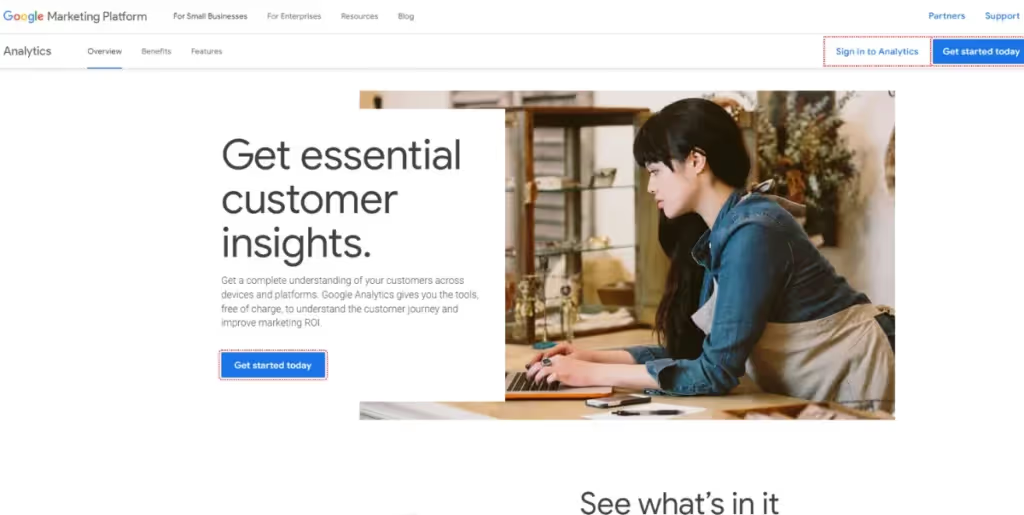
Google Analytics (GA) is a user data platform that tracks and displays how users interact with your website across all platforms and devices.
GA shows you all of this in one simple location:
- How long visitors stay on your website
- How often they achieve a goal (long stay, clicks, inquiries, etc.)
- Does a user visit your site and leave quickly (“bounce rate”)
- How many pages they visit each session
- How often they return
- Where they’re coming from, and which devices they’re using
Once you know the who, what, when, where, why, and how of visitor behavior, you can begin to experiment with optimizing different aspects of your customer experience.
The only downside to GA is that it doesn’t do much sentiment analysis or store or analyze the data for you (at least not much). It’s mostly just for visualizing user behavior data.
2. HeyMarvin
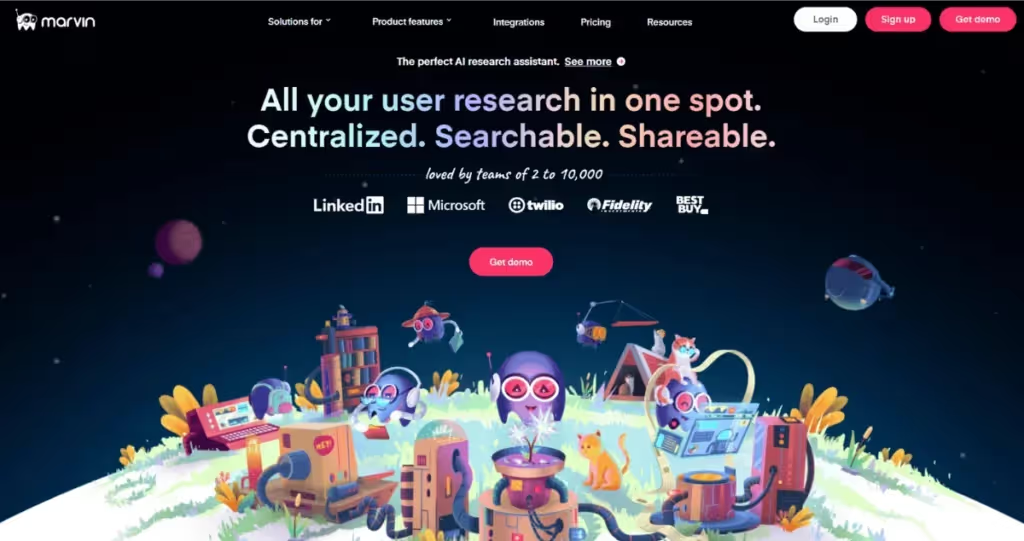
HeyMarvin is an AI-native consumer insights platform. It turns your research into a living system that gets smarter over time and makes insights easier to find, share, and act on.
The platform is built for UX researchers, product teams, customer experience teams, and research operations leaders. Teams can store interview transcripts, survey analysis, usability tests, support conversations, and other research data in one place.
Key capabilities include:
- Use of AI to speed up synthesis and analysis: It can search across old projects, reports, and research documents to find relevant evidence and connect insights across studies.
- Strong focus on research repositories and insight management: Other tools, such as Google Analytics and Hotjar, help teams understand what customers do. HeyMarvin helps teams understand why they do it.
- A powerful AI research assistant: It will save you time, reduce duplicate research, and improve collaboration between teams.
- Integrations with other relevant tools: HeyMarvin integrates with Slack, Notion, Confluence, Jira, Salesforce, etc. to help you bring research insights into your workflows.
Companies such as Wave have used the platform to connect research findings more closely to product decisions. Here’s how they describe the experience:
“We had all the data, but we weren't using it. And now, I can put those three reports together much faster and circulate them to the whole company. And everybody has this pulse on all of these things that are happening. We can get to a concrete insight in probably half a day. It's easier to get that out to the whole org and to inform their foundational base of knowledge.”
3. HotJar
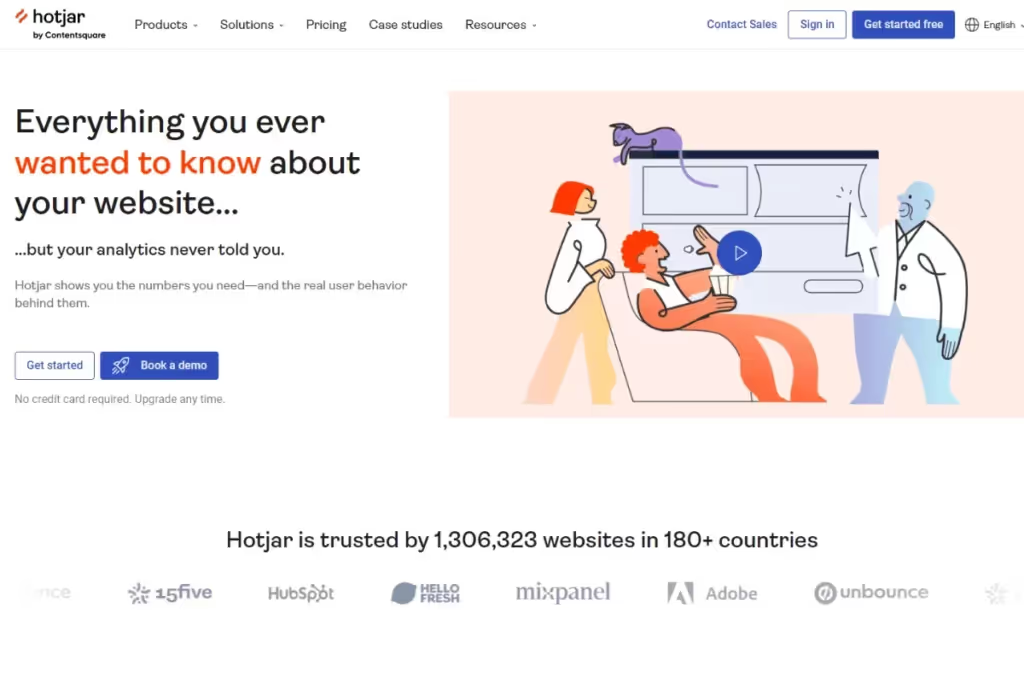
HotJar is a product experience insights tool that shows you how visitors interact with your web pages at a micro level.
In plain English, HotJar puts you in your users’ shoes so you can see exactly what they’re thinking when they’re on your page.
With this data, you’ll know what drives a customer to convert, what they ignore, or what’s getting in the way. This type of knowledge empowers you to make data-driven changes to improve conversions and optimize your customer experience on all of your pages and each step within your sales funnel.
4. Medallia
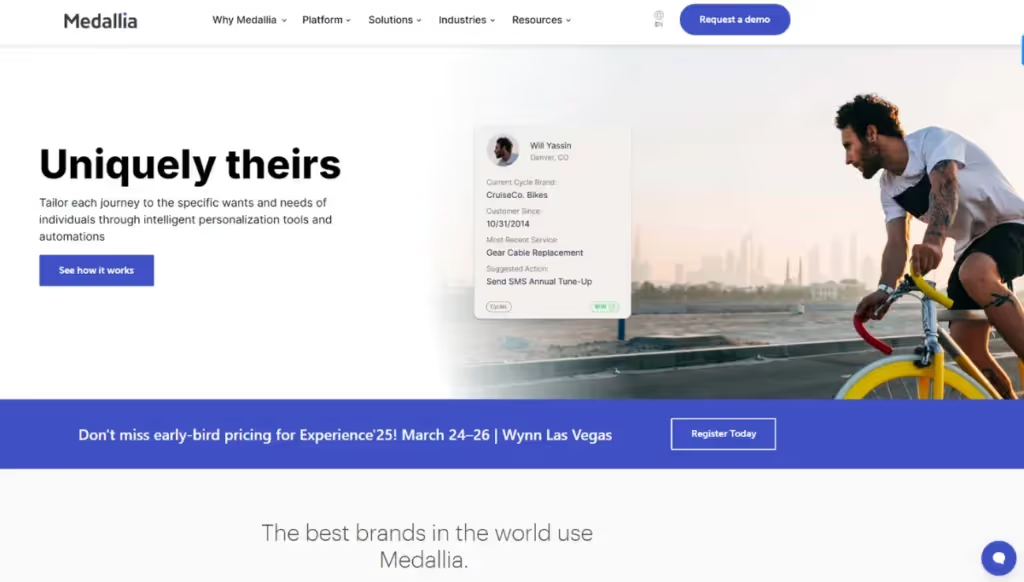
Medallia is an enterprise customer experience feedback tool used by large businesses, higher learning institutions, and Fortune 500 companies. It lets you optimize the entire customer journey using behavioral analysis, feedback, data analysis, and AI-driven insights.
If you’re looking to understand how your customers interact with your business, how they feel about each touchpoint in the process, and what you need to do to optimize everything, Medallia is the platform for you.
Medallia excels in the following areas: customer feedback, actionable insights, and long-term business optimization.
5. Google Trends
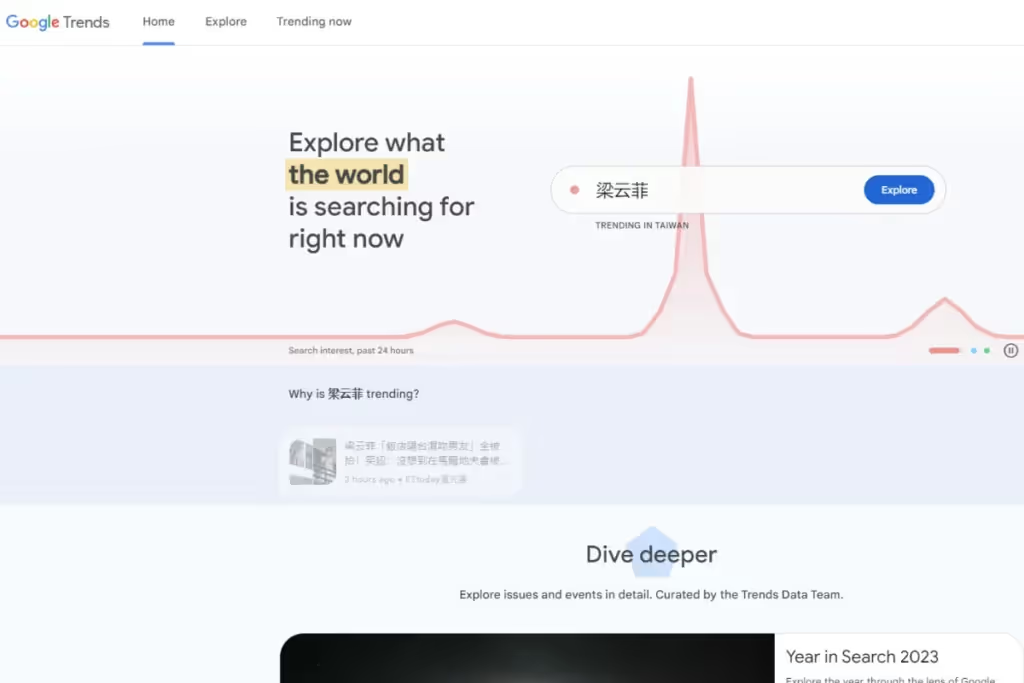
Google Trends is a free consumer data analysis tool that shows you search trends, emerging patterns, and new content ideas, so you can tailor your marketing towards what’s trending in different areas.
It’s the best way to spot the “next big thing” in your industry and get a head start on competitors.
Think about it this way…
Say you’re a SaaS company looking to create new content or ads. All you’d have to do is look for your topic in Google Trends, and you’d see a ton of valuable data to help tailor your campaigns to precisely what your audience is searching for right now.
6. Qualtrics
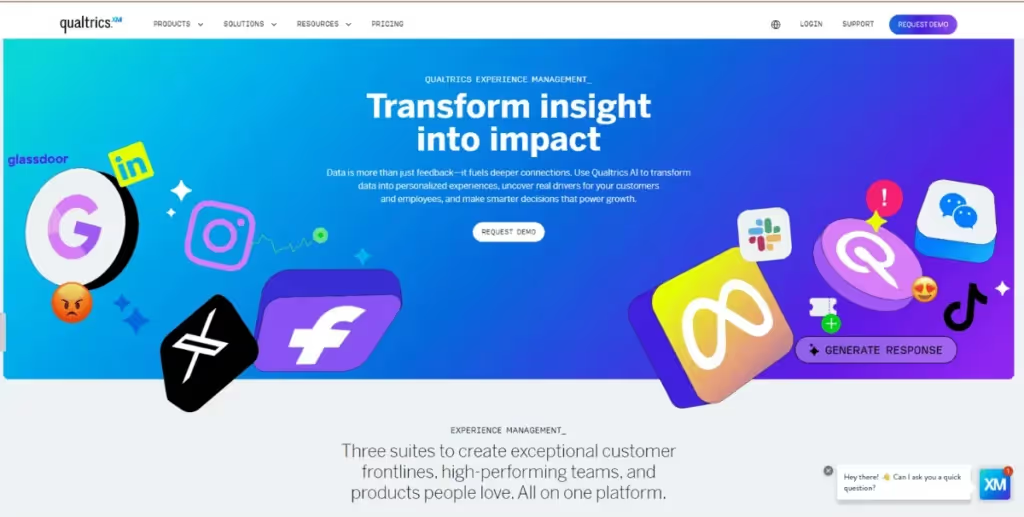
Qualtrics is a customer and employee experience management tool for optimizing your business by asking the right questions, listening to feedback, and taking action based on AI-driven insights.
One of their biggest selling points is that they have services tailored to certain industries like education, finance, and healthcare. By the way, in those industries, delivering better experiences is probably the #1 competitive advantage. The happier a customer or employee is, the healthier your business is. Period.
If we had to sum it up, Qualtrics helps you:
- Deliver better customer experiences
- Retain employees by actually listening to their gripes and fixing key issues
- Make smarter business decisions (like designing better products) through feedback collection and predictive analysis
7. Gong
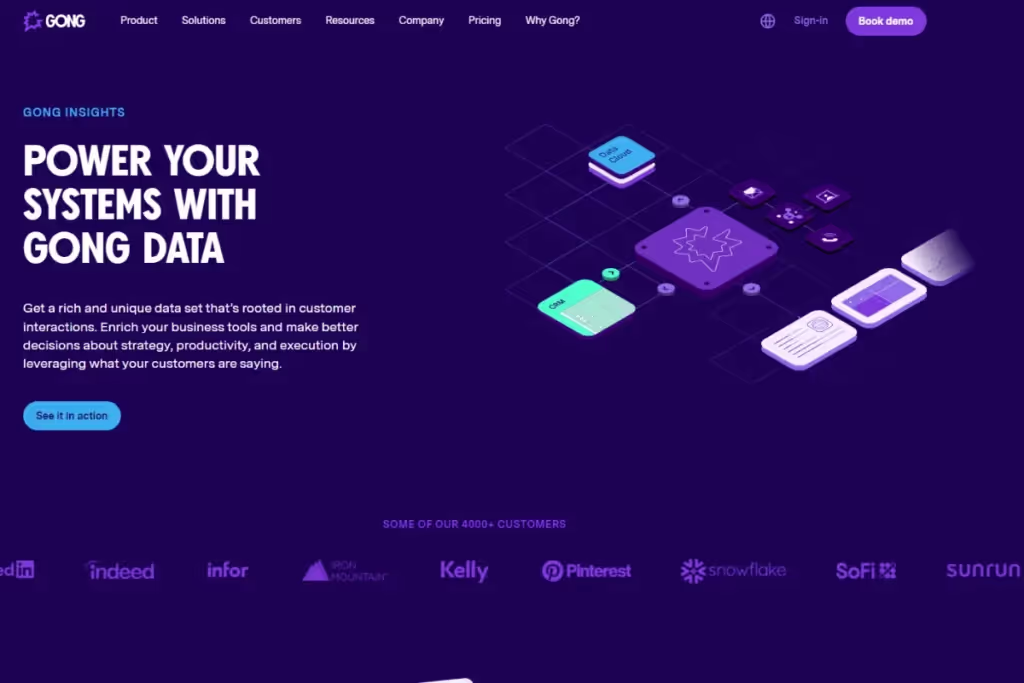
Gong is a consumer insights platform that stores, summarizes, and analyzes customer and employee interactions, then uses AI to provide actionable insights for sales, marketing, and human resources.
The cool thing about Gong is it connects directly to your CRM and automatically updates and syncs with sales/team data for even more insight and actionability.
This makes it easier to track progress, set and achieve goals, improve products and processes, and make informed decisions.
Gong is best for:
- Sales teams
- Market research
- Employee performance
Gong also features integrations with CRM, revenue intelligence, and business systems, connecting customer conversations to broader operational data.
8. Amplitude
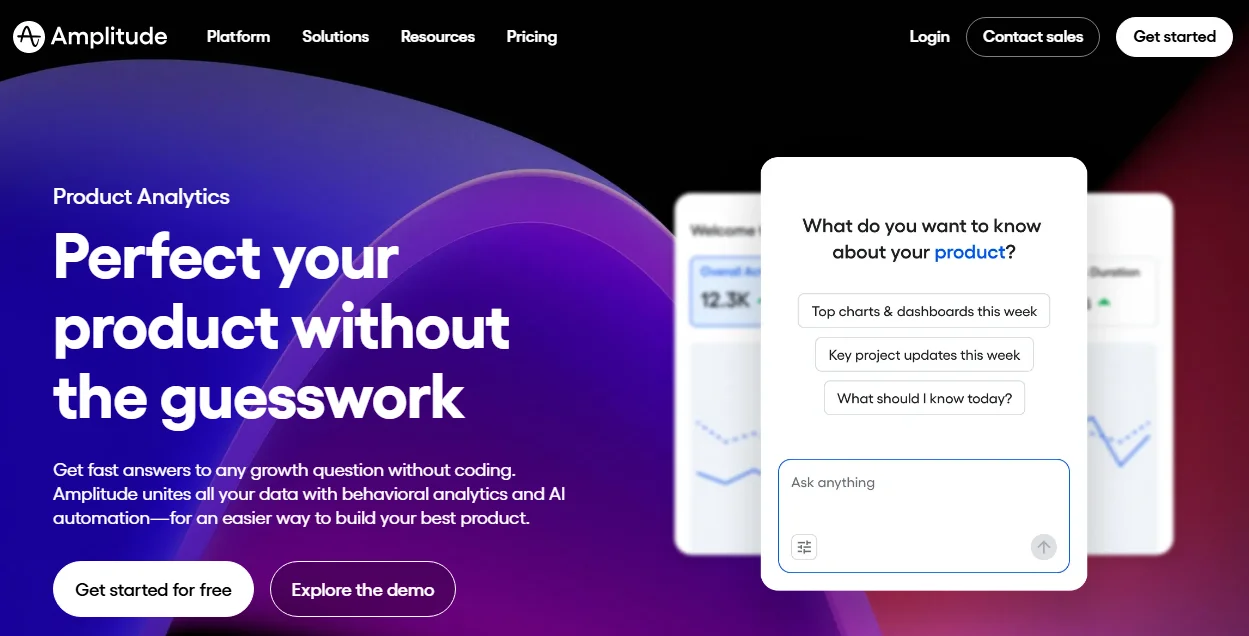
Amplitude is a product analytics platform you can leverage to understand how people use your product.
It’s particularly effective at pointing out what drives growth, retention, and conversions. And it does so by tracking user behavior across your website or app and turning that data into easy-to-understand reports. You can see which features people use most, where they get stuck, and what actions lead to long-term engagement.
With Amplitude, you can connect user behavior to business outcomes. You identify friction points, test new ideas, and prioritize product improvements based on real customer data.
If your goal is to understand what customers do within your product, this analytics tool will help.
9. Fullstory
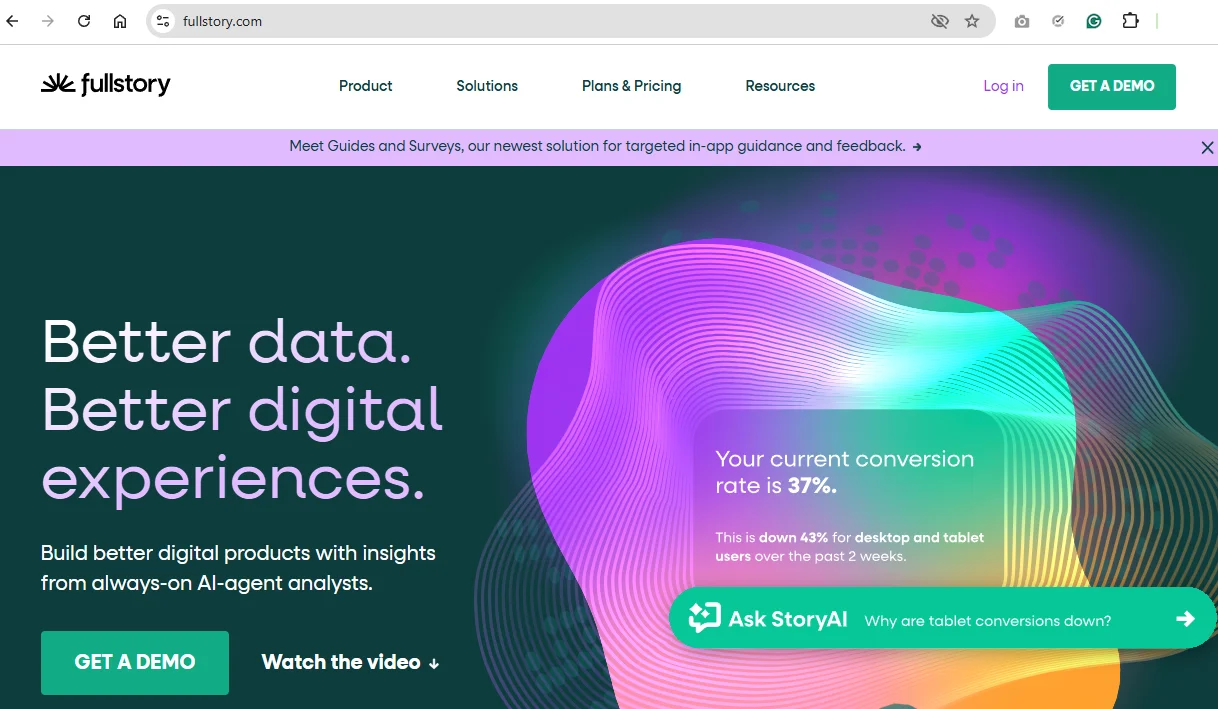
FullStory is a behavioral analytics platform that helps you see your digital experience through your customers' eyes.
That means you no longer have to rely on reports and dashboards alone. You can watch how people actually move through your website or app.
The platform combines session replay, journey mapping, and behavioral analytics. And it reveals where friction exists and how it affects conversions, retention, and customer satisfaction.
If your team spends a lot of time asking why users drop off or struggle to complete tasks, FullStory can help you find the answer.
10. Mixpanel
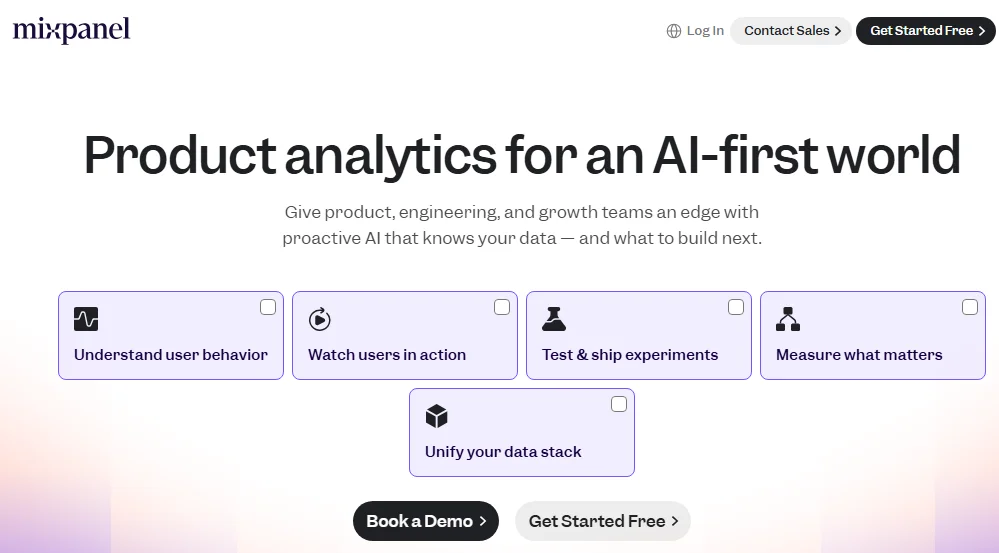
Mixpanel helps product teams measure the impact of product changes using funnels, retention reports, user segments, and behavioral analytics.
With this event-based product analytics platform, you track user behavior and how changes affect engagement, conversion rates, and long-term customer retention.
Mixpanel tracks metrics that connect directly to business performance. Product, growth, and marketing teams can all work from the same data and track progress toward shared goals.
For teams that care about measurement, this tool turns product activity into numbers they can actually act on.
The platforms we reviewed address different consumer insight challenges, but HeyMarvin can support you throughout the entire workflow. Schedule a free demo to see how this platform helps you organize customer knowledge and turn research into usable consumer insights.
What the top consumer insights tools have in common
The best consumer insights software should help you collect, organize, analyze, and act on customer data without adding unnecessary complexity.
But not all consumer insights solutions support the same capabilities. That is why, before choosing, you should take time to evaluate the features that matter most to your team.
Consider the following key features:
Relevance
First off, look for a consumer insight solution that fits into your business and helps you achieve your goals.
What’s most important to you?
Improving customer retention? Optimizing sales? Enhancing internal performance and retention?
You want the tool to feel like it was built just for you. That way, you're not just collecting large amounts of customer data — you’re getting clear, actionable insights that produce tangible results for your specific business needs.
Scalability
Your consumer insights tool should be able to grow with you without any hassles.
What if your traffic doubles? Will the platform be able to keep up?
Cloud-based systems are designed to handle increased data volume effortlessly with features like flexible data storage and advanced analytics that perform well under pressure.
Here are a few of our favorite scalable features:
Security
The best consumer insight tools take data privacy and security very seriously.
Look for a consumer insight tool with encryption, two-factor authentication, user permissions, and GDPR, HIPAA, and SOC2 compliance.
Select a tool that has a good mix of security and privacy features and conducts comprehensive audits to ensure your data is always protected.
User-friendliness
User-friendly consumer research tools are rare, so make sure you schedule a demo with the tool and look for the following features:
The truth is that most consumer insight management platforms have a steep learning curve.
The easier the tool is to learn and use, the happier you’re going to be.
Customer Support
Customer support is going to make or break your experience with the insights platform you choose.
That is why You want a team of knowledgeable, REAL people to help you set things up, customize the software to your business’s needs, and solve issues as soon as they arise.
You also want a tool that guides you on adding new features and walks you through how to interpret advanced data.
Mistakes to avoid when using a consumer insight tool
Here are some of the most common mistakes we see people make with consumer insight tools:
No clear purpose before data collection
Before you start collecting customer data, decide the purpose behind collecting the data.
Don't just start asking customers for feedback when they leave your site. Instead, define what you’re trying to do.
For example, are you trying to reduce churn? Are you curious about what your customers think about your brand? Are you trying to optimize your sales funnels?
Once you define your goal, you can then set criteria for collecting and evaluating the data.
You can still use simple customer satisfaction surveys — just make sure you know why you’re doing it.
The risk of unvalidated user data
Customers will often say one thing and do another, so you need to make sure that the survey results match what’s happening in the real world.
You know how when the waitress comes to your table and asks you how your food is, you always say “It’s amazing” even if it’s bad? Customers will do the same.
So, don’t just take survey results at face value.
Use other data like onsite behavior, purchasing history, and direct interviews to make sure it reflects reality.
Overlooked social data sources
You need to look beyond a handful of data sources to all the social platforms, blogs, and forums your customers use. This includes Facebook, LinkedIn, Twitter, Instagram, news sites, and general blogs.
Social listening can also complement consumer insight research, revealing opinions and trends that may not appear in surveys or interviews.
Gather as much data as you can.

Frequently asked questions (FAQs)
Here are answers to common questions about consumer insights tools, how they work, and what they cost.
How do consumer insight tools differ from market research tools?
Consumer insight tools focus on understanding your existing customers’ behaviors, preferences, and experiences by analyzing data you already have, like purchase history or feedback.
Market research tools, on the other hand, are more about gathering information on the broader market, including potential customers, competitors, and industry trends.
What are the costs associated with implementing consumer insight tools?
The costs of implementing consumer insight tools can vary depending on the tool and the features you need. Some tools charge a monthly subscription fee, which can range from affordable plans for small businesses to more expensive options for larger companies. There might also be costs for setup, training your team, and integrating the tool with your existing systems.
Costs can range from free plans and low-cost subscriptions for small teams to well over $10,000/month for enterprise deployments.
Can small businesses benefit from consumer insight tools?
Small businesses can benefit just as much, if not more, from consumer insight tools than large businesses. These tools help you really get to know your customers — what they like, what they need, and how they behave. With this understanding, you can adjust your products, services, and marketing to better meet their needs, which can lead to more sales and loyal customers.
Even if you don’t have a huge customer base, knowing these details gives you an advantage over competitors. You can make better decisions based on real data instead of guessing.
How many consumer insights tools does a team actually need?
When you're just starting out, a core platform that covers primary research, analysis, and insight management should be enough. As your research practice evolves, you can add specialized tools to fill some of the gaps in the core platform. The fewer tools you combine, the easier it becomes to avoid overlapping functionality, data silos, and challenges with insight sharing.
Conclusion
The tools you’ve seen in this guide are only part of the decision. The harder question is: does your team have the infrastructure to turn research into actionable consumer insights? Or are you still losing insights between research and product teams?
HeyMarvin is an AI-native consumer insights platform that unifies research into a living knowledge system. Schedule a free demo and see how your whole team can use it to find, share, and act on consumer insights.

See Marvin AI in action
Want to spend less time on logistics and more on strategy? Book a free, personalized demo now!