


The Best Qualitative Insights Platforms for Research Teams
See how qualitative insights platforms turn customer conversations into actionable insights, compare platform types, and evaluate AI analysis with confidence.



You spend hours searching Zoom recordings, a survey tool, the help desk, and shared drives. You ask colleagues which study covered renewals. But the question you started with is still open.
Why do enterprise customers downgrade at renewal?
The answer often already exists. It's spread across 30 interview recordings, a few hundred open-ended survey answers, and a quarter's worth of support tickets. By the time you pull it together, your team has often made the roadmap decision without it.
A qualitative insights platform keeps that research and feedback in one place. That helps you find an answer and check it against the original quotes.

TL;DR: Qualitative insights platforms in brief
- A qualitative insights platform is a research platform that helps you collect, analyze, store, and share qualitative data. That data includes interview transcripts, open-ended survey answers, and support tickets.
- The category spans three kinds of research platform. Collection-led platforms run studies, qualitative analysis tools are built for deep coding, and insights hubs let you search and reuse research across studies. Some platforms span two kinds.
- Judge a platform's AI on whether every claim links to a source quote you can open. In a 2026 PLOS Digital Health study, most AI coding errors came from tagging the facilitator's words. You catch that mistake by opening the quote.
What a qualitative insights platform does at each stage
A qualitative insights platform helps you turn unstructured customer conversations and feedback into insights. An insight is an interpretation of customer data that explains why people think, feel, or behave the way they do.
Qualitative data includes research data you collect, such as interviews, and feedback that customers volunteer, through support tickets, reviews, and sales calls.
A research platform automates much of the work at each stage of a qualitative study. Those stages cover everything from running interviews to sharing findings.
Here's what the platform does at each stage, and the calls that researchers need to make:
Research keeps its value when people can find and reuse it.
If your team needs to know why enterprise customers downgrade at renewal, a shared taxonomy helps. Once every study follows the same tags, you can search the 30 interview recordings, survey answers, and support tickets from the opening as one body of evidence.
You can also find questions past research already answered before you run a new study. That depends on sound qualitative research coding practice.
Research that's easy to find and reuse is more likely to inform decisions. In April 2026, HeyMarvin surveyed 309 researchers, research consumers, and research leaders for its State of Modern Research 2026 report.
At organizations with an active insights repository, 85% of respondents said their organization references research often or almost always in major decisions. At organizations without one, the share was 60%.
For almost every major decision, the shares are 43% and 12%. Having a repository isn't enough on its own, since about 36% of organizations with one describe it as "stagnant". Read the report to see what keeps a repository in use.

Three kinds of qualitative insights platforms
Each research platform starts from one core job that shapes what it does best.
The State of Modern Research report refers to insights hubs as insights repositories. A platform can also span more than one kind.
Here's how the three kinds compare:
Analysis approach is the dimension that matters most for speed and rigor.
Here's how the three approaches compare:
- Manual coding: Gives you the most control, but it scales slowly.
- Rule-based coding with keyword dictionaries: Fast and repeatable, yet it can't tell when the same word means different things.
- AI-led analysis: The fastest of the three. In one 2026 study, it matched human coders when applying an agreed set of tags. Its results vary more across studies and when it generates themes from scratch, so researchers review AI output either way.
The six best qualitative insights platforms
Here's how the six compare, based on each vendor's website and pricing page. The cost columns reflect each vendor's pricing page on October 26, 2026.
1. Marvin
Best for: Research, product, and design teams that run studies, analyze all their research and feedback in one hub, and share insights with decision-makers.
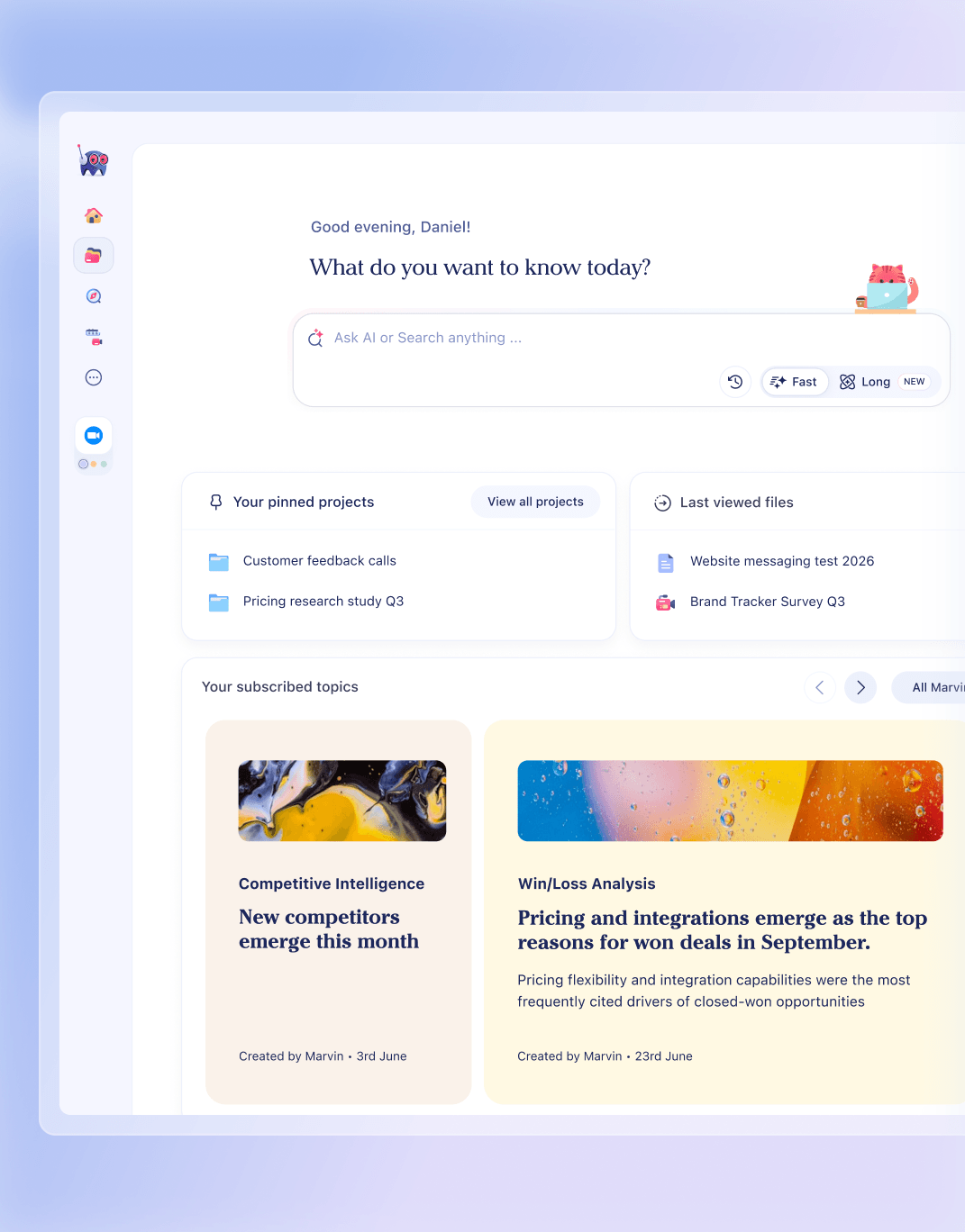
Marvin is an AI-native customer insights platform that covers research from running studies to sharing insights.
The AI Moderated Interviewer runs voice interviews in more than 40 languages. The interviewer works from your discussion guide and asks follow-up questions at the depth you set for each question. Live Intercept invites site visitors and people using your product to a voice interview at the page or in-product event you choose.
You can also run live interviews yourself. The AI Notetaker transcribes and takes notes on Zoom, Google Meet, or Microsoft Teams calls.
To recruit from your own customers, the research panel syncs participant contacts from your CRM. Surveys, support tickets, sales calls, and docs come in through more than 30 integrations.
Analysis Studio works within one project or across many. Its AI writes auto-notes, groups notes on affinity boards, and labels excerpts in bulk. The AI also runs thematic and emotion analysis.
Deep Research runs hypothesis testing, jobs-to-be-done analysis, and question-and-answer tables across your data.
The Knowledge Hub stores every study under a global taxonomy. Ask AI answers questions with citations to source quotes.
You can share insights through reports, video clips, Slack, Salesforce, and Figma. Marvin MCP lets Claude, ChatGPT, and Copilot query that research.
Included Health reported four times the research output in a year, without adding researchers or budget.
Marvin has four plan tiers, including a free plan, with access varying by seat type. The three paid tiers have custom pricing.
Strengths: Citations on every Ask AI answer, and viewer seats that give stakeholders read-only access to insights. Controls include US or EU data residency. HIPAA compliance, automatic PII redaction, and Okta and SAML SSO are available on Enterprise or with the Compliance add-on on Pro. Marvin holds a SOC 2 Type II report and ISO 27001 and ISO 42001 certifications, and is GDPR compliant.
Keep in mind: Marvin doesn't include product analytics. If you need click and funnel data, add a dedicated analytics tool.
Your own research is the most useful test of any platform. Book a demo and bring a past study to see how Marvin cites the source quote for every answer.
2. CoLoop
Best for: Insight teams and agencies that analyze large volumes of interviews and focus groups.
CoLoop supports planning, recruiting, interviewing, and analysis in one place. Its analysis links each insight to supporting quotes and full transcripts. The Memory feature lets teams query past projects.
Strengths: Transcription in more than 100 languages, a check that the analysis includes every participant, PII masking, EU or US hosting, and SOC 2 reports.
Keep in mind: CoLoop organizes work by research project, so pilot it on your ongoing feedback, such as support tickets.
3. Discuss.io
Best for: Market insights teams running live video interviews and focus groups across many countries.
Discuss.io supports live interviews, live virtual focus groups, AI-moderated interviews, and asynchronous video feedback. Its AI agents help set up studies and summarize interviews against your research questions.
Strengths: Recruiting in more than 100 markets, unlimited team members, and both AI-moderated and live interviews on every plan.
Keep in mind: Discuss.io focuses mainly on market research fieldwork. Recruiting is an add-on on every plan below Enterprise.
4. Dscout
Best for: Research teams running in-context studies, such as diary and field studies, where participants record experiences as they happen.
Dscout covers diary studies, interviews, usability tests, intercepts, and AI-moderated studies. Research teams can use Dscout's panel or invite their own customers. Dscout's AI summarizes studies, suggests themes, and answers questions with sources.
Strengths: Rich-media intercept studies, recruiting filters that target participants by behavior as well as demographics, and Dscout MCP for querying studies from AI assistants.
Keep in mind: Pricing depends on seats and research volume, and intercept studies start on the Select plan.
5. MAXQDA
Best for: Researchers who need rigorous, code-by-code analysis and mixed methods on a defined dataset.
MAXQDA is a desktop qualitative analysis tool for Windows and Mac that also supports mixed methods research. Researchers code by hand and run dictionary-based text analysis with MAXDictio. They can use the AI Assist add-on for tasks such as summaries.
Strengths: Fine control over coding, statistical analysis in the Analytics Pro edition, and AI Assist, which the vendor describes as GDPR-compliant.
Keep in mind: MAXQDA is a single-user program. Teams collaborate by merging project files or through the TeamCloud add-on. TeamCloud covers a team lead and up to four members, each with their own MAXQDA license.
6. Dovetail
Best for: Teams that want to centralize customer feedback and research in a searchable workspace.
In Dovetail, which its maker calls a customer intelligence platform, teams centralize customer interactions and research in one workspace. Its AI features draft reports and briefs linked to their sources.
Strengths: Manager, Contributor, and Viewer roles, data redaction, custom retention, and audit logs on its Enterprise plan.
Keep in mind: The free plan covers one project and one channel, a stream of feedback Dovetail tracks and analyzes. The only paid plan is Enterprise, where HIPAA support is a paid add-on.
How to choose a qualitative insights platform
Start with the step where your research slows down. That bottleneck tells you which kind of platform to buy.
- Name the bottleneck: Can't run enough studies? Look at collection-led platforms. Is your analysis taking weeks? Look for AI-led analysis with citations. Does your past research go unused? Look at an insights hub.
- Map your sources and readers: List every place your qualitative data is stored and every person who needs answers from it. A platform that can't connect to your support desk or give stakeholders read access becomes one more silo.
- Run a bake-off on a study you've already tagged: Upload transcripts your team tagged by hand and compare the themes each platform finds. Open every cited quote to confirm a participant said it. For a collection bottleneck, also run a short AI-moderated study on each platform. Review follow-up depth, language coverage, and the participant experience.
- Check governance before procurement does: Confirm PII redaction, role-based access, data residency, and whether vendors train models on your data. Ask for a SOC 2 Type II report and ISO 27001 certification. If AI processes sensitive data, also ask for ISO/IEC 42001, the standard for AI management systems.
- Price it for everyone who'll use it: Seat-based pricing grows with each person who needs access. License-based pricing grows with each analyst you add. Custom pricing depends on the studies and data volume you negotiate.
How a fintech team ran its bake-off
Suppose you're on a fintech research team. You're running the bake-off from step 3 on 18 renewal interviews you'd already tagged by hand into nine themes. One platform finds eight of the nine but attributes two of the interviewer's quotes to participants.
A second platform finds seven of the nine themes. Every quote opens at the right timestamp in the right speaker's turn.
Which do you pick? The second, because a researcher spot-reading transcripts can catch a missed theme. But a misattributed quote looks correct and can reach a leadership deck unnoticed.

How to check AI analysis before you rely on it
Greenbook's 2026 GRIT Insights Practice Report names three tasks where agentic AI is already part of insights work. They're analyzing data, updating reports, and preparing data.
The same report names AI governance as a critical gap. Governance here means policies for how AI may use data and who's accountable for its output.
A blinded comparison published in PLOS Digital Health in April 2026 tested three general-purpose LLMs against two human analysts. University of Southampton researchers ran it on one focus-group transcript with seven participants.
When applying a predefined set of codes, the models were non-inferior to the humans, with 93.5% agreement against 92.7%. Only one model matched humans at generating themes from scratch.
Of the AI-coded segments, 12.4% contained some error, mostly from coding the facilitator's speech. The authors note that results from a single transcript may not hold in other contexts.
A scoping review of 75 studies in BMC Medical Research Methodology appeared in June 2026. Across those studies, agreement between LLMs and human coders ranged from 36% to 99%.
Agreement fell as tasks became more interpretive and rose with better prompts and validation. In 97% of the studies, a human verified the AI's output.
Those findings support a short verification routine for AI qualitative data analysis. Here's what to check:
- Exclude interviewer speech from tagging.
- Have a second researcher tag a sample of excerpts in each study.
- Open every quote behind a headline insight.
Do you let AI generate themes from scratch? Keep the second-researcher check in every study, since that's the more interpretive task.
For example, say your readout has five headline insights. You'd open the quotes behind all five before the deck goes to leadership.
AI can take on more of the tagging. But you still choose the questions, decide which themes hold up, and judge what an insight means for the business.
Choose a platform that makes past research easy to find and check
The right research platform makes every past conversation searchable and every claim checkable before your team makes a decision.
But past research stays useful when new studies keep adding to it.
Marvin runs studies with its AI Moderated Interviewer and brings interviews, surveys, and customer feedback into one Knowledge Hub. Ask AI then answers questions with citations.
Get a demo to see the AI Moderated Interviewer run interviews with participants recruited from your own customers.
Frequently asked questions
General-purpose assistants can hold uploaded transcripts in a project and answer questions about them. But they don't keep a shared taxonomy, research permissions, or consent records across your team's studies.
Some insights platforms connect to these assistants through MCP. That lets you query your research from the assistant while the platform's permissions and citations still apply.
A research or ResearchOps lead usually owns the taxonomy, consent rules, and review of AI-generated themes. PMs and designers add data and run lighter studies, while stakeholders get read access. That split keeps tagging consistent as more people contribute.
A research or ResearchOps lead usually owns the taxonomy, consent rules, and review of AI-generated themes. PMs and designers add data and run lighter studies, while stakeholders get read access. That split keeps tagging consistent as more people contribute.

See Marvin AI in action
Want to spend less time on logistics and more on strategy? Book a free, personalized demo now!