.png)
.svg)


How to Conduct Effective Customer Analysis (Tools Included)
Master key techniques and tools to understand customer behavior, drive insights, and enhance business strategies.



If you don’t know what your customers want, how will you give it to them?
Customer analysis solves this conundrum. A key component of business strategy, it helps companies truly understand their customers.
What are their greatest needs? What hurdles do customers face in fulfilling these needs? What are the most effective marketing channels to reach them?
Answer all these questions (and more) by conducting a thorough analysis of customers.
Our comprehensive guide introduces you to the different types of customer analysis. We’ll outline the benefits (and limitations) it brings to the table and show you how to conduct effective customer analysis. Finally, we'll share a list of our favorite customer analysis tools to help in your search.
Want to skip the deep dive and see our favorite customer analysis tool in action? Request a demo of HeyMarvin today!

What is customer analysis?
Customer analysis involves quantitative and qualitative data collection to extract meaningful insights about current and potential users. Analyzing insights helps researchers ascertain customer needs, preferences, motivations, frustrations, and behaviors.
Key stakeholders use insights to inform business decisions:
- Sales and marketing teams identify potential customers. They create targeted plans with promotion, pricing, and branding strategies.
- Product development pinpoints areas for improvement. They take steps to enhance their product and address customer needs.
- Business leaders can identify strengths and weaknesses in their product offerings. They can spot new opportunities to act on.
Conducting customer analysis builds on a company’s foundational knowledge. User insights inform strategic decisions that help companies and their customers.
A win-win scenario.
What are some examples of customer analysis?
Let’s look at two popular examples of customer insights:
- Amazon uses dynamic pricing strategies for goods on its website. Analyzing customer shopping patterns, product popularity, and competitor prices informs their pricing decisions. Prices fluctuate daily — this maximizes revenue opportunities based on supply and demand.
Ever wonder why Amazon product suggestions are almost always on point? Amazon uses your purchasing and browsing behavior to provide personalized recommendations.
- Similarly, Netflix keeps its viewers hooked to its platform by providing content recommendations. Monitoring viewing patterns, habits, and in-app behaviors helps tailor suggestions to various users.
Netflix has a handle on what captivates their audiences. They’ve even forayed into creating original content to much acclaim.
Customer insights analysis enables data-driven decisions that enhance the user experience and boost turnover.

Essential components of customer analysis
Customers have their own mix of needs, expectations, habits, and motivations. They don’t base buying decisions solely on price or features. What they want today might change tomorrow. And to make it all the more complicated, their words don’t always match their actions.
That’s why customer analysis can be challenging and why you must always look at as many data points as possible.
To truly understand your customers, you need a combination of the following components:
The importance of customer analysis
Create unique and tailored experiences for your customers. Improve customer satisfaction and expand your business’s reach.
Here’s why you need to incorporate customer analysis into your business strategy:
- Better Understanding of User Journey: Chart a user’s path from beginning to end:
Awareness → Consideration → Comparison
→ Testing → Negotiation → Service.
Identify points of friction and track feature
adoption within applications.
- Increased Efficiency: Combine quantitative and qualitative data to understand how to strategically allocate resources. Expand your reach with more concentrated efforts — look for customers in the right places. Cut out any unwanted and unnecessary procedures.
- Personalized User Experiences: Make product enhancements based on feedback. Act on feature requests and decide which ones to prioritize. Drive user engagement by tailoring experiences and messaging to different user groups.
- Improved Customer Loyalty: Maintaining strong relationships with customers is crucial to keeping them happy. Customize products to meet existing user needs and messaging to address them effectively. Satisfied customers become product advocates.
- Reduced Customer Churn: Finding new customers is more expensive than retaining existing ones. Conduct the right analyses to focus on existing customers’ needs. Understand why customers leave or switch to competitors. Better retention equals fewer customers lost.
- Lower Customer Acquisition Costs: Acquiring new customers involves costly strategies such as targeted advertising. Analysis reveals channels and customers that bring high value. Companies can fine-tune their efforts — expanding their reach while cutting costs.
- Effective Customer Service: Collect feedback from surveys to uncover where customer support falls short. Proactively helping customers keeps them engaged, satisfied, and loyal. As a company that listens to customers, it only adds to your brand’s credibility.
- Increased Revenue: Streamline marketing operations to understand factors that positively or negatively impact sales. Identify customer needs and deliver them to guarantee a constant revenue stream. Drive sales by refining products or creating new ones.
Customer analysis is beneficial for everyone. It helps companies fine-tune their business strategy to deliver products that customers love. In turn, this attracts more customers and, therefore, sales.

Types of customer analysis
More than grouping people into segments, customer analysis reveals who your customers are, how they behave, and what drives their decisions. But it can’t do it all at once, which is why there are multiple types of analysis you can use.
Each type looks at your audience through a different lens. Some show you important traits, while others highlight behavior patterns or reveal what motivates people.
When you use all four of the approaches we detail below, you get a fuller understanding of your customers.
1. Geographic analysis
Where do customers live? Geographic analysis divides the target market into specific categories based on physical location.
How do location-specific factors (climate, culture, population density, and language) affect customer behavior?
People living in the same areas have similar mindsets, cultural preferences, and requirements. By grouping users who live in the same country or region, companies gain insights into where their target customers are.
2. Demographic analysis
Groups customers by identifiable characteristics such as age, gender, and income. Demographic information is easy to collect on a large scale. Inexpensive to carry out, it takes minutes to set up and distribute a feedback form.
Businesses learn who their target audience is.
3. Behavioral analysis
Companies collect, examine, and interpret data about customers’ interactions with a product. Analyzing behavioral data helps firms understand and predict user behavior. Customer behavior is further divided into categories:
- Buying Criteria: What needs are unmet? What features will they appreciate most? What are they willing to pay?
- Purchasing Patterns: What do they buy? How frequently? What’s their decision-making process? What information do they consider?
- Engagement: What features do they use? Are customers satisfied? If not, why? What sales channels do they prefer?
- Customer Journey: How many are repeat customers? What is their lifetime value? What portion of customers churn? Why are they churning?
Behavioral analysis reveals how various customers behave while immersed in the product.
[This list barely scratches the surface. Learn about the various tools for user testing.]
4. Psychographic analysis
Analyzes people based on psychological characteristics such as values, aspirations, and beliefs. It helps weigh the importance of several factors in customer decision-making. Because characteristics are subjective, this analysis involves the most fieldwork. (It's also arguably the most valuable.)
Companies monitor online feedback from customer reviews or social media mentions. They must also carry out their own surveys, interviews, and focus groups. It helps them delve deeper into understanding customer wants, frustrations, and needs.
Psychographic analysis provides insight into the underlying motivations behind people's thinking, helping companies understand why customers take certain actions.
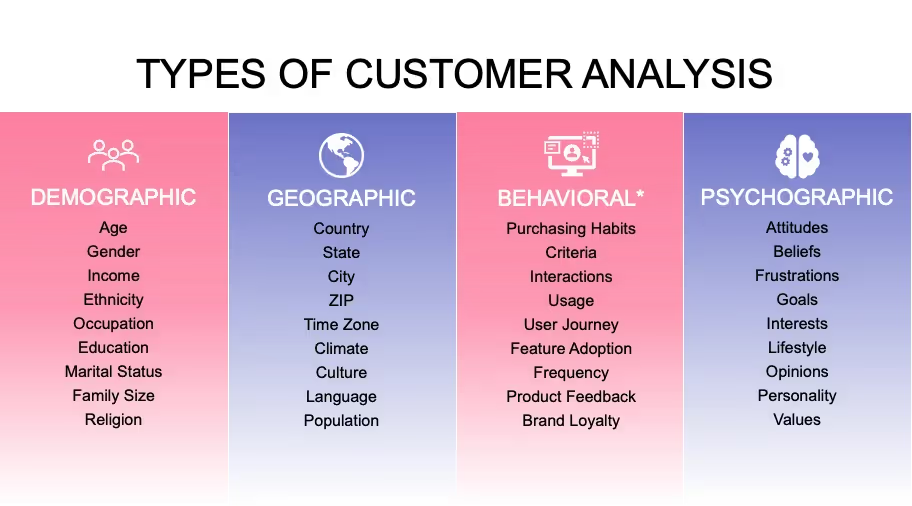
*not exhaustive
How to do customer analysis effectively
What do you want to achieve from your analysis?
Define your strategic objectives at the outset. Answer these questions:
What data do you need to collect? How will you collect, analyze, and apply it?
Here are a few tips and tricks to get the most out of your customer analysis:
Analyze existing customers
Leverage your firm’s internal knowledge. Collect customer insights from across departments to understand different perspectives. Perform the following analyses on your current customer base:
- Segmentation. Group customers into logical buckets (using the section above as a guide). Create distinct groups with similar traits and motivations.
- Needs. Needs analysis helps identify customers’ main purchase drivers. It informs future product development.
- Profitability. Identify your most valuable customers. Use metrics such as lifetime value (LTV) and repeat purchase rate to identify customers with longevity. Keep these customers happy, attract more like them, and watch revenue grow!
Collect user data
Every user touchpoint is also a data point. Data provides insight into the user experience, allowing businesses to improve their processes. Take these steps to optimize data management:
- Automate Data Collection: Integrate a variety of data sources to get a comprehensive view of the user experience. Capture user data at every step. Customer analysis tools can streamline data collection from a host of applications.
- Capture the User Voice: Product analytics dissect customer behavior. If you want to know customer motivations, i.e., what they want, just ask! Periodically gather qualitative feedback. Stay in touch with evolving user needs and marketplace trends.
- Data Sanitization: For accurate analysis, prepping and cleaning your data is vital. Review the data to ensure it's fit for use. Inspect for any anomalies, errors, or inconsistencies. These skew results and cause erroneous conclusions (and decisions).
- Centralized Customer Data: Consolidate all data onto a single, unified platform. Reduce information silos by making it accessible to across departments. Sales, customer success, developers, product, designers, and researchers. We mean everyone!
Learn why HeyMarvin is the Research Repository tool of choice for UX professionals.
Develop user personas
Once you’ve collected data and established a target audience, it's time to create user personas.
A fictionalized representation of various users, it personifies customer data. Personas accurately detail demographic, psychographic, and behavioral information. Tracking user interactions with a company uncovers users’ preferences and needs.
Marketing, sales, and product onboarding teams can tailor communication to different user types. Once personas are established, these teams can conduct research to develop these further. They create personalized campaigns that target the right audience and resonate with users.
Head over to our guide on how to create dynamic user AI personas.
Visualize data
Visualization tools help educate key stakeholders and decision-makers.
Map the user journey to represent the customer lifecycle. Every touch point is an opportunity to understand user needs and discover areas for improvement. Uncover whether users have positive experiences (or not).
Journey maps help you identify how to engage with customers and convert them into sales.
Tableau and Power BI help researchers identify patterns and trends from large datasets. Use these tools to segment customers, chart their satisfaction, and evaluate business performance. Companies benefit from stakeholders making data-driven decisions.
Convert insights into action
Collecting and organizing raw data is merely the process. What does your customer analysis tell you?
Extract insights out of your data to make informed decisions. Get to the bottom of what users really want and need in a product. Develop an action plan to make improvements to the customer experience.
Validate features and product updates by testing with users. Incorporate their feedback to remove roadblocks and fix bugs. Equipped with this information, you can make smarter decisions to optimize business processes.
Turn challenges into solutions. It all begins with understanding the stories that data tells you.
Iterate
Customer analysis is an ongoing task, not a one-off exercise.
User tastes and preferences change like the seasons. With the landscape in constant flux, it's essential for businesses to keep up with market trends. By aligning themselves with customer needs, businesses keep their finger on the pulse.
An understanding of user requirements and behavior informs business strategies. Companies concentrate their efforts on generating impactful product changes and messaging. Analysis can reveal new opportunities, while ensuring existing customers are being heard.
Stay ahead of the curve — conduct customer analysis on the regular.
The role of AI in customer analysis
Traditionally, customer analysis is slow and repetitive. No matter how dedicated you are as a researcher, it’s hard to maintain focus, accuracy, and calibration when sitting for hours on end to review interviews, survey responses, support tickets, or whatever type of feedback you’re working on.
This is where AI can support you effectively in your entire workflow.
Using AI in customer analysis doesn’t mean giving up control, as some may fear. It actually means giving up time-consuming manual tasks, while regaining mental bandwidth for the decisions that truly matter.
AI helps you process data faster and go deeper, reaching insights you might have missed on your own. Here’s where and how it makes the biggest impact:
- Automates repetitive tasks such as transcription, summarization, tagging, and clustering, giving you back hours of your time.
- Turns your research into an open book that you can interrogate at will and get accurate, relevant answers in minutes.
- Uncover patterns and connections by looking at large volumes of data to group similar feedback, identify themes, and highlight trends.
- Compare insights from different sources (such as interviews and surveys) to confirm your insights and reinforce your decisions.
- Support faster and smarter decision-making by speeding up the repetitive work and saving you time for validation and interpretation.
All these obvious benefits left aside, there’s still the common concern around accuracy. Does using AI in customer analysis improve data accuracy?
The truth is, AI can reduce manual errors and process large datasets consistently. But it doesn’t “guarantee” accuracy. It works with the data and context you provide, and it can still miss nuance or generate incomplete answers.
That’s why you must review AI output. While AI helps you arrive at insights faster, it’s still you who gets to decide what’s true, what’s relevant, and what to act on.

Our favorite customer analysis tools
You need the right software to understand customer behavior and needs. What are users doing? Why are they doing it?
How do you choose from the vast universe of customer analysis tools? We’ve got you covered. Here’s a list of our favorite customer analysis tools:
HeyMarvin
HeyMarvin is home for all your research data.
Import NPS surveys and HeyMarvin analyzes responses to generate a report of findings. Stitch together interview footage into a playlist to share with key stakeholders. Use quantitative and qualitative data to develop a well-rounded idea of customer experience.
Use Marvin’s Ask AI feature to interrogate ALL your data. Ask questions like, “What are customers saying about feature X?” HeyMarvin scours your project library and generates summarized insight.
HeyMarvin is designed to augment your workflow, not disrupt it. Continue working with the apps you love. Leverage Marvin’s integrations to import various data types into one tool.
All your customer analysis under one roof. That’s Marvin.
Book a free demo with HeyMarvin to discover all its customer analysis features and why users call it a “game changer”.
Google analytics
This is one of the most popular web analytics tools. Consider using it to monitor key customer behavior metrics across platforms or to manage advertising campaigns and track their ROI in the application.
How many users are visiting your website? What device are they using? How long are they spending on your website? What elements do they interact with? How many visitors drop off?
Answer these questions and more with Google Analytics. Bear in mind that it only offers quantitative metrics.
Hotjar
Hotjar captures and tracks visual user behavior data. Collect product experience insights in real time.
The application tracks a user’s behavior across websites and mobile apps. Heatmaps identify high-attention areas on web pages. Use session recordings to track customer journeys.
Hotjar’s easy-to-use interface lets you create in-app feedback widgets to collect real-time data. Users can convey exactly what they’re going through and their frustrations (if any). Hotjar combines qualitative and quantitative data in roll-out surveys and polls.
Mixpanel
A product analytics platform for websites and mobile applications. With real-time user data, Mixpanel helps you chart the user journey.
Break down user actions and create funnels to understand conversion metrics. Mixpanel offers customizable reports to track user retention, drop-off, and feature popularity. Refine your conversion process — engage with users, convert, and retain them using Mixpanel metrics.
While Mixpanel offers plenty of integrations, it can be complex to use.
Woopra
Woopra tracks user interactions on websites. It builds a profile of every visitor in real time, tracking them across touchpoints. It tracks geographical data that helps marketers improve marketing campaigns.
Use the application to segment users into different groups based on their behavior. Personalize their experience using their powerful automations. Add triggers for customer actions and send users personalized messages.
Woopra is super easy to set up. However, the free version offers limited functionality, and the paid plans are expensive for small teams.
What are the challenges in customer analysis?
Beware of these challenges while conducting customer analysis.
Evaluate your data to ensure you’re not lacking in any of the following:
- Requirements: Analysis suffers without a clear understanding of what you’re looking to discover. Clear goals help you choose the right data sources, methodology, and KPIs. Collected data must relate to business objectives; otherwise, it’s not useful.
- Quality: High-quality data is accurate, complete, consistent, and relevant. Poor data quality leads to erroneous insights. Decisions based on misleading insights can adversely affect a company. Evaluate your data for the following:
- Accuracy & Consistency: Web analytics, surveys, interviews, and social media capture customer feedback differently. Validation helps eradicate data inconsistencies such as duplicates, spelling, and formatting. Validate, clean, and catalog data before using it for analysis.
- Completeness: Capturing only part of the customer experience leads to bias. Poor resource allocation and decision-making follow. Avoid these:
- Unilateral analysis is when researchers consider only one aspect of the data, neglecting the rest.
- Superficial analysis only scratches the surface of the analysis without considering underlying information.
- Relevance: Customer attitudes and needs evolve over time. Stay up to date with market trends. Use reliable data sources. Regularly collect, validate, and clean data using the right methods and tools for analysis.
- Privacy: Companies collect users’ personal and identifiable information (PII). To gain customer trust, they must be wholly transparent about how they collect and use data. Adhere to local data privacy guidelines to protect sensitive user information.
[HeyMarvin is GDPR, HIPAA, and SOC2 compliant, so your user data is ALWAYS protected.]
- Inaction: If data collection and analysis is the process, acting on insights is the end game. Actionability means using data to make decisions, solve problems, and implement changes. Incorporate changes, see what gets a response, and keep your ears to the ground.

Frequently asked questions (FAQs)
Here, we answer the most frequently asked questions about customer analysis:
How often should customer analysis be updated?
Long story short — the frequency of updating customer analysis depends on numerous factors. Pay close attention to shifting industry trends, customer preferences, and technological advancements.
Here are some tell-tale signs that it's time to update your customer analysis:
- Feature / Product Updates: Companies add features to enhance the user experience. They gather feedback on particular updates and bug fixes. Customer analysis helps determine whether they are successful or not.
- Change in Customer Statistics: If customers suddenly become dissatisfied with a product or service, it shows. CSAT scores may dip, and customer churn increases. Similarly, it's helpful to identify factors that increase satisfaction and reduce churn.
- Evolving Customer Habits and Preferences: Regularly conduct research to understand the fluid user expectations. Update your data periodically to capture trends as they change over time.
- New Products or Markets: As businesses explore the potential of new markets (and audiences), it becomes crucial to understand their users better.
Businesses must conduct customer analysis periodically to track progress and changes.
How do you measure the success of your customer analysis efforts?
Use KPIs and metrics to measure the success of your efforts. The most obvious way to track success is to look at lagging indicators for your business:
- Shorter sales cycles
- Higher customer satisfaction scores
- Faster speed to market
- Lower cost of acquisition
When you do the hard work of analyzing your customers’ experience, your bottom line will thank you.
What is the difference between customer analysis and market analysis?
As the terms suggest, the difference between “customer” and “market” analysis is in what you focus on.
Customers are part of the market. When you’re running customer analysis, you’re trying to understand the people who buy from you, their needs, behaviors, preferences, and pain points.
The market is the environment where customers operate. When you’re conducting market analysis, you’re looking at the bigger picture and trying to understand the size of the industry, the trends, the demand, and even the competitors.
What makes customer analysis actionable?
The way you frame your insights is what actually makes customer analysis actionable. If, for instance, you’ve identified a specific customer pain point, your analysis should also reveal how it impacts your business and what you should do about it.
For every single customer insight, you need clear next steps. Otherwise, no one will know what to make of your findings, and they won’t drive action.
What is the difference between qualitative and quantitative customer analysis?
Qualitative customer analysis is the process of examining open-ended, language-rich data to understand why customers think and behave the way they do. Interviews, open-ended survey responses, and user feedback are the most common sources in this type of research.
Quantitative customer analysis focuses on reducing customer feedback to numerical data. Whether it’s conversion rates, retention metrics, or survey scores, this data shows the frequency of particular customer behaviors, attitudes, or sentiments.
In short, qualitative analysis explains the reasons behind customer behavior, while quantitative analysis measures and validates it at scale.
Conclusion
Customer analysis helps you paint an accurate picture of your customers. An integral part of a business strategy, it pinpoints user behavior, needs, motivations, and preferences.
Everyone at an organization benefits from customer analysis. From marketing teams to product development teams, it helps them connect with their target audience better.
Companies who understand their customers can tailor products and experiences to customer tastes. It helps highlight potential issues so companies reduce the risk of customer churn.
In a rapidly evolving landscape, customer analysis helps businesses stay relevant by responding to ever-changing customer needs.
Looking for a tool that helps you understand your users? Look no further. Set up a free demo with HeyMarvin today to see how it enhances your customer analysis.

See Marvin AI in action
Want to spend less time on logistics and more on strategy? Book a free, personalized demo now!