Why company brains need customer knowledge
As AI strategies take shape, research leaders have a chance to make sure customer knowledge is part of them.



Nearly every company we talk to is building some version of a company brain. Leadership wants AI that knows how the business works, so teams are wiring up wikis, docs, Slack, and CRM data and pointing their AI tools at all of it. Y Combinator's Tom Blomfield even added a company brain to YC's Summer 2026 Requests for Startups, calling it "the missing layer between raw company data and reliable AI automation."
A company brain is a shared, always-current layer of company knowledge that people and AI tools draw on. Most are built from what the company knows about itself, like product specs, process docs, and decisions. What customers have told you usually isn't in there.
Customer knowledge needs to be part of this brain. Without it, AI can give confident answers about the wrong things.
The single-player AI problem
AI use is close to universal. In our State of Modern Research 2026 report, a survey of 309 researchers, research consumers, and research leaders, 93% use or experiment with AI. Most of that use happens in general-purpose tools: 59% use them, compared with 35% who use AI built into research tools.
A general-purpose AI tool only knows what someone gives it about your customers. In our survey, nearly half (48%) of respondents whose teams use general AI assistants for research have no actively used repository behind them. So one tool might have a PDF from last spring, another a few anecdotes from a handful of support tickets, and a third nothing at all.
Arnab Bose, chief product officer at Asana, calls this single-player AI: tools that "assist one person, in one conversation, disconnected from the wider business." Ask two of those tools the same customer question, and you can get two different answers. A product manager and a designer walk away with conflicting conclusions, and neither knows it.
The alternative is multiplayer AI, where people and AI tools work from shared context. Microsoft's 2026 Work Trend Index found that its most advanced AI users, which it calls Frontier Professionals, were more likely than everyone else to say their teams "share AI tips, new agents, learnings, and mistakes" (61% vs. 36%). A company brain is how organizations try to make that sharing systematic, and customer knowledge belongs in it.
Why the company brain needs a customer context layer
The obvious objection is fair. If customer knowledge is missing from the company brain, why not connect the research drive and call it done?
It's a reasonable first step, and some teams start there. The trouble is that customer knowledge is unusually hard for AI to use well. It lives in recordings, open-ended survey answers, and interview notes. In February 2025, Gartner predicted that "through 2026, organizations will abandon 60% of AI projects unsupported by AI-ready data." A folder of transcripts is about as far from AI-ready as data gets.
While a product fact can simply be stated as true, a customer quote needs a citation back to its source, which is what makes it trustworthy. Search alone can't trace a quote to the right moment in an interview recording or tell a customer's words from an interviewer's question.
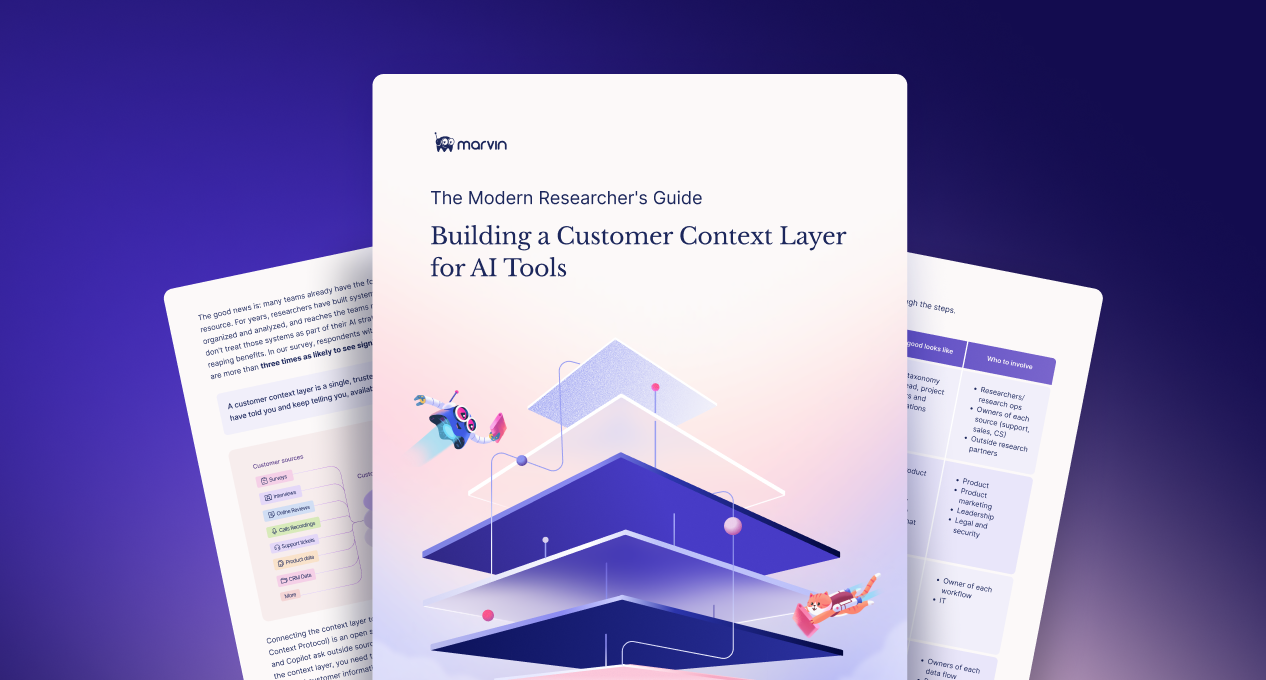
That's why the customer side of the company brain needs its own structure. It needs to work as a customer context layer so that teams have a single, trusted source of everything your customers tell you, available to every team and every AI tool.
Teams with research repositories already have a head start
The good news is that many research teams have already built most of the foundation. For years, researchers have built repositories in platforms like Marvin, where customer data flows in, gets organized, and reaches the people making decisions.
Those teams are getting more out of AI. In our survey, respondents with an actively used research repository are more than three times as likely to see significant AI time savings (51% vs. 16%).
The missing step is usually the connection. Open standards like the Model Context Protocol (MCP) let AI tools such as Claude, ChatGPT, and Copilot ask outside sources for context, so a customer context layer connected once can reach every compatible tool.
athenahealth's design team keeps its research in Marvin and connected it to Figma Make through Marvin MCP. "By using MCP connectors, we are no longer designing in a vacuum," says Katherine McVey, Senior Product Designer. "We are designing with the context of our user research right inside our Figma files."
What research leaders should do now
A company brain is quickly becoming part of every company's AI strategy, and the customer brain belongs in that strategy too. That's why research leaders need to be in the room where AI decisions get made. Researchers know which evidence is solid, how to organize findings so they hold up, and when a pattern is strong enough to act on. Build that judgment into the layer from the start, and every AI tool that draws on it inherits a researcher's standards.
Building the layer comes down to four steps. Structure your customer knowledge so AI can read it, ground it in your company's own facts and terminology, connect it to the tools people already use, and keep it current as customers keep talking. Our guide walks through each one, with examples from teams already doing it.
Every company will soon have a company brain. The best ones will know the customer as well as the business.
Frequently asked questions
A company brain is a shared, always-current layer of company knowledge that people and AI tools draw on to answer questions and get work done. It usually connects internal sources like wikis, docs, chat, and CRM data. The goal is for every AI tool to work from the same understanding of how the business runs.
A customer context layer is a single, trusted source of everything your customers have told you and keep telling you, available to every team and every AI tool. It brings together interviews, surveys, support tickets, sales calls, and reviews, keeps every claim cited to its source, and stays current as new feedback arrives. Think of it as the customer side of the company brain.
A customer context layer is a single, trusted source of everything your customers have told you and keep telling you, available to every team and every AI tool. It brings together interviews, surveys, support tickets, sales calls, and reviews, keeps every claim cited to its source, and stays current as new feedback arrives. Think of it as the customer side of the company brain.
Single-player AI describes tools that help one person in one conversation, without shared context from the rest of the business. Multiplayer AI is the alternative, where people and AI tools work from shared plans, workflows, and context. A company brain, with customer knowledge inside it, is one way to make AI multiplayer.
The most direct route is the Model Context Protocol (MCP), an open standard that lets AI tools like Claude, ChatGPT, and Copilot ask outside sources for context. Connect the layer once, and every compatible tool can draw on the same customer knowledge. Our MCP basics guide covers how it works.

See Marvin AI in action
Want to spend less time on logistics and more on strategy? Book a free, personalized demo now!