.png)
.svg)


What Is Market Segmentation Research? Types and Examples
Explore market segmentation methods, real-world examples, and the tools that make insights actionable.



The power of market segmentation research is hard to ignore.
Take LEGO as an example. After decades of focusing on children, the company identified a fast-growing segment of adults. Their new, dedicated product line for adults brought a 27% revenue increase that year and 17% growth the following year.
If you need help implementing market segmentation, this guide is for you. From the actual process to the right market research tools, we cover it all. We’ll even show you how AI can speed up research without sacrificing rigor.

What is market segmentation research?
Market segmentation research identifies the smaller groups (segments) within a broad audience to inform product decisions.
A group includes consumers who share common traits and are likely to respond similarly to your product.
Audience segmentation research zooms out to determine how people relate to a message, channel, or brand. Market segmentation zooms in to clarify:
- Who the consumers are as people (B2C)
- What kind of companies they are and how they buy (B2B market segmentation research)
The main types of market segmentation research
Each of the main types of market segmentation research serve a specific purpose. But they also come with specific limitations, which is why combining them might be useful.
When discussing how to do customer research for segmentation, most online guides barely mention the firmographic angle. But in B2B research, this approach is essential for understanding the types of companies you’re serving. One can be a 30-person SaaS startup. And the other a 300-person financial services firm. Even though they both are on your growth plan, they buy for completely different reasons.

How to do market segmentation research
If you already have a product with users, you’ll spot some segments naturally in your data. But if you're at an early stage with no existing user base, conduct exploratory segmentation to understand your audience.
Either way, the process involves the following steps:
1. Pull together what you already know
Go through everything you’ve collected, from your analytics and CRM data to support tickets and past research.
With just a few months of usage data, you should be able to sketch some behavioral segments.
2. Choose your segmentation variables
A variable is a characteristic of your user: age, login frequency, company size, motivation, etc.
Most projects work with anywhere from 3 to 6 variables.
With fewer than 3, you might end up with segments that are too broad to act on. More than 6 can quickly make your market segmentation analysis unwieldy (especially with a limited sample size).
3. Collect primary data
Surveys and interviews are the most common methods of market segmentation research.
You can use surveys to reach a large number of people quickly. Conduct interviews to go deeper with the most relevant users.
Combining methods helps you balance scale (from surveys) with granular details (from interviews).
4. Analyze for patterns
Find clusters of people who behave or respond similarly.
If you have a decent sample size, statistical clustering methods will help you start. Otherwise, you can use affinity mapping across your interviews.
Research by Dolnicar et al. provides some guidance. A sample size of roughly 70 times the number of segmentation variables you're working with is adequate for reliable clustering.
Therefore, if you're segmenting across 3 variables, you need around 210 respondents. Across 5 variables, closer to 350.
5. Define and describe your segments
The clusters you identified become your segments. Each one needs a name, a brief profile, and a clear description of what sets it apart.
Create a realistic summary of the shared traits, behaviors, and needs for your teams to use in marketing and product decisions.
6. Test your segments against real data
Before using these segments in your product development, you must validate them. The goal is to confirm whether the people in a segment behave the way you'd expect.
For instance, you’re targeting "power users in mid-market SaaS companies." In this case, you might want to validate whether the cohort has higher retention or faster activation rates.
7. Put the segments to work
Use the segments you found to decide what to build next, how to tailor flows, or how to speak to different buyer types.
And don’t forget to revisit them once a year or soon after significant events. Product updates, new pricing tiers, or sudden churn all deserve some segment investigation.

Market segmentation research examples
You’ve already seen the LEGO example earlier in this guide.
Netflix is another popular example of how behavioral segments can drive constant investment in the right area. The company moved away from broad demographic targeting (age, income). Instead, it focused on viewing habits, genre preferences, binge-watching patterns, and completion rates to build behavioral segments.
Nike’s strategy is similar. It focuses on selling to distinct behavioral segments with separate product lines: serious runners, casual gym-goers, sneaker collectors, and fashion buyers.
But Nike’s segmentation also reveals an example one should avoid. Days before this year’s Boston Marathon, they had to pull a store campaign due to controversial messaging. A sign reading "Runners welcome. Walkers tolerated." sparked backlash from the running community.
Behavioral segmentation told Nike that runners were a priority segment. It didn't tell them how best to speak to that segment. That's psychographic territory, and it's a good reminder that different segmentation types answer different questions.
How AI is changing market segmentation research
AI gives you direction and allows you to go deep into your research within the shortest time. You still need to feed it clean data and keep the judgment calls to a human researcher. But it is definitely changing market segmentation research by facilitating:
- Faster research and analysis: AI can collect and scan hundreds of responses, surface recurring themes, and flag anomalies quite fast. What took a researcher two weeks now takes an afternoon.
- Pattern detection at scale: Humans tend to find patterns they're already looking for. AI has more chances to find clusters you weren't expecting in data you couldn’t handle manually. It can discover a high-value user type buried where nobody had thought to look.
- Segmentation updates: Market research automation software makes it easier to update segments over time with AI. Instead of one big segmentation study every 18 months, teams can run continuous analysis on incoming data.
Top 3 market research tools that keep segmentation insights usable
Below are 3 market research tools for segmentation that will make your work easier.
One is an AI-native research repository and analysis platform that supports your workflow end-to-end. The other two facilitate individual research methods and integrate with the top-rated option.
1. HeyMarvin
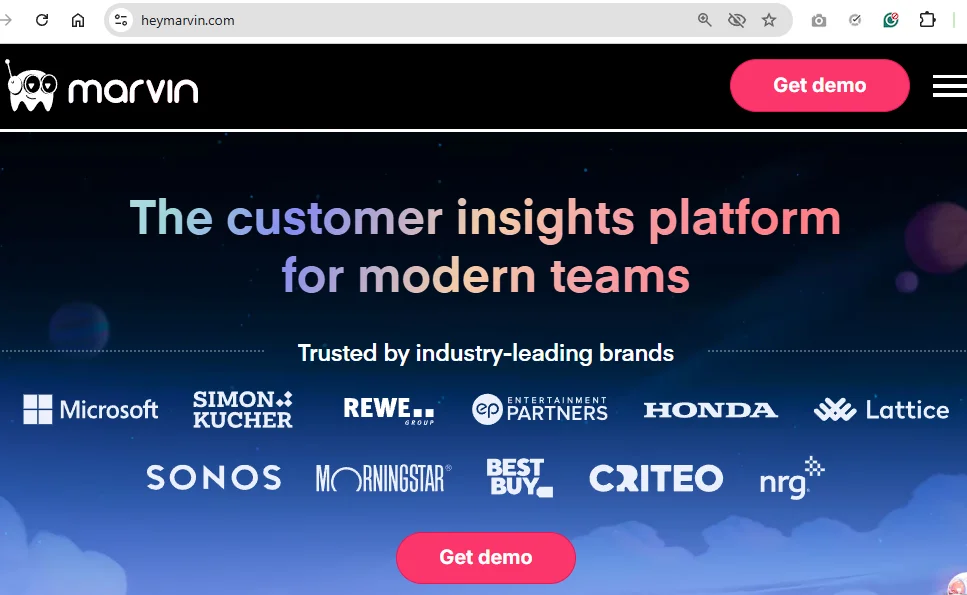
Segmentation research generates substantial qualitative data, including interviews, open-ended responses, and usability sessions. HeyMarvin helps teams analyze that kind of data while also providing support for quantitative data analysis.
Its AI can surface patterns across hundreds of conversations. It will also tag themes and pull cited evidence so you can link to actual user language.
What makes it genuinely useful for segmentation work is the research repository. Teams can search for existing studies, extract relevant findings from past projects, and build on prior work.
Modern teams, such as Microsoft, trust HeyMarvin. To go deeper on how to make segmentation insights usable, download our Make Customer Insights Impossible to Ignore guide.
2. SurveyMonkey
SurveyMonkey uses branching logic and conditional question flows, which makes it effective at maintaining high completion rates.
This tool is especially handy in longer psychographic or attitudinal questionnaires. And its built-in respondent panel helps run segmentation research on markets you don't yet have access to.
Within the platform, you can filter responses by demographic or behavioral variables.
3. Mixpanel
This is a product analytics tool that watches in real time how users engage with your web or mobile applications. It tracks how they interact with your product, how often they return, and where they drop off.
Consider it if you need segments that account for actual behavior rather than what people tell you in surveys. Mixpanel can show you which users log in three times a week and frequently use two core features. Or which ones have only signed up, clicked around, and never came back.

Frequently asked questions (FAQs)
Here’s what else you should know before you begin your market segmentation research:
What is the difference between market segmentation and customer segmentation?
Market segmentation looks at the broader market, including people who don't use your product yet. Customer segmentation research focuses on the people who already use it to help you serve them better.
How long does a market segmentation research project typically take?
According to common research practice, basic studies with surveys and a moderate sample size can take 6 to 7 weeks. Add qualitative interviews, B2B recruiting, or in-depth assessments for multiple market segments, and it may take 12 weeks.
What data is needed to conduct market segmentation research?
It all depends on the type of segmentation you're running. For behavioral segmentation, usage and event data are most relevant. Psychographic segmentation works best with survey responses and interview findings. CRM data and screener surveys are essential for demographic and firmographic segmentation.
What makes a market segmentation study actionable?
A segment is only useful if it predicts a behavior, a need, or a decision pattern. If you can't look at a segment and immediately know what to build for that audience, you need more research. Or better analysis.
Conclusion
When you do market segmentation research properly, you always know exactly who you’re building for. And finding out isn’t even the hard part. Most teams can design a survey, run some interviews, and produce a list of segments. What's harder is making those segments usable today and in 6 months.
HeyMarvin can help you speed up this process while keeping your insights accessible and up to date. Our platform was built to ensure your research insights don't disappear after the debrief.
Book a free demo today to see HeyMarvin in action. We’ll show you how AI-powered analysis, a searchable repository, and cited evidence can change how your team works with research.

See Marvin AI in action
Want to spend less time on logistics and more on strategy? Book a free, personalized demo now!


.webp)