.png)
.svg)





Overview
Research is only as valuable as the decisions it informs. Marvin makes sure every insight is cited, searchable, and trusted. An LLM like Claude makes a strong thinking partner for what comes next — the strategy doc, the PRD, the battlecard, the executive memo.
Marvin is an expert on your internal data. An LLM adds the external layer: market trends, competitive benchmarks, academic frameworks, and broader industry context. Together, you can take verified internal findings and position them against the wider landscape in a single workflow.
Neither tool replaces the other. But when they're connected, work that used to take days collapses into one conversation.
How the connection works
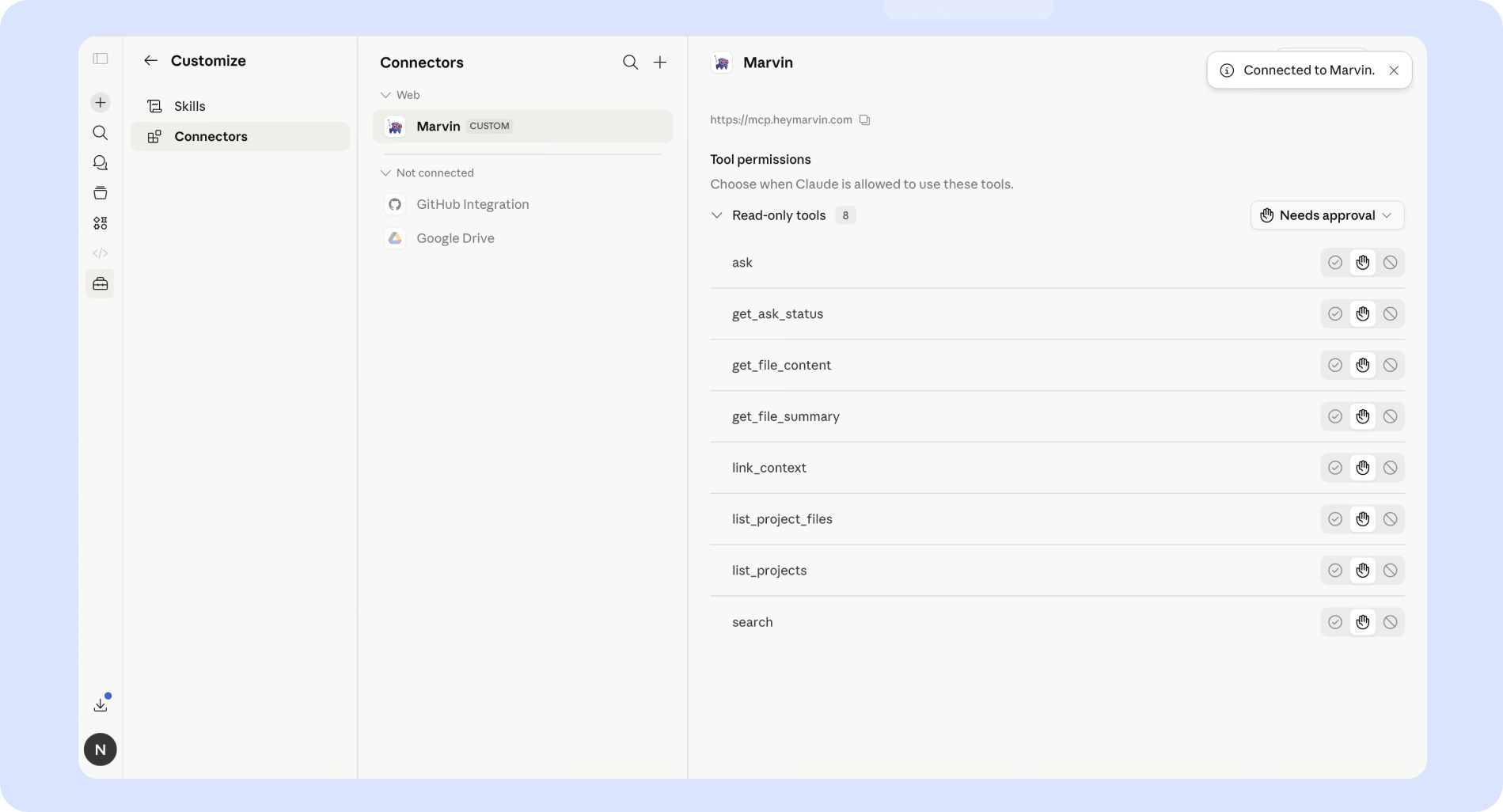
Marvin connects to Claude through MCP (Model Context Protocol). To set it up, add Marvin as a custom connector in Claude's connector panel. Once you've authenticated, Claude can read your Marvin projects directly. Ask a question, and Claude pulls from your Marvin knowledge repository without needing to export data or copy and paste between tabs.
Popular Use Cases
For product managers: Write a PRD grounded in customer evidence
Skip the roadmap debate. Pull real customer pain points, feature requests, and usage patterns from Marvin and have Claude structure them into a PRD that's ready for engineering review.
Example prompt: "From our Marvin project on [Product Area], pull the top five customer pain points and the most-requested feature improvements. Then write a PRD for [Feature Name] that includes a problem statement grounded in those findings, proposed solution, success metrics, and known risks. Cite specific customer quotes where relevant."
For product marketing: Create competitor battlecards
Your competitive intelligence lives in Marvin, win/loss interviews, demo feedback, customer comparisons. Claude can shape those insights into battlecards your AEs will actually use.
Example prompt: "Using our Marvin win/loss interviews and demo feedback, create three one-page sales battlecards: one each for [Competitor A], [Competitor B], and [Competitor C]. For each, include their key positioning, where we win, where we lose, top customer objections, and a recommended talk track. Ground every claim in a specific customer quote or data point from Marvin."
For product marketing: Build product messaging for a launch
Launch messaging that sounds like marketing copy falls flat. Launch messaging grounded in how customers describe the problem lands. Pull the real language from Marvin and have Claude build your messaging framework around it.
Example prompt: "From our Marvin research on [Product/Feature area], pull the most common ways customers describe this problem and the language they use when talking about the value they want. Then draft a messaging framework for the launch of [Feature Name] that includes a headline, three supporting value propositions, a 50-word positioning statement, and a short-form product description for the website. Keep everything grounded in customer language, not marketing speak."
Pro tip: You can also upload your brand's style and tone guidelines in Marvin and build a "messaging editor" skill in Claude to ensure everything you write stays on brand.
For customer marketing: Draft a customer story from an interview
The best customer stories use the customer's own words. Marvin has the full transcript, cited and searchable. Claude turns it into a narrative your prospect will actually read.
Example prompt: "Pull the transcript from [Customer Name]'s interview in Marvin. Draft a 600-word customer story that covers the challenge they were facing, why they chose us, and the results they've seen. Use their exact language where it's compelling, and structure it for a web page with a pull quote and key metrics callout."
For market researchers: Triangulate pricing research against the market
Marvin holds your internal pricing research, willingness-to-pay data, feature importance rankings, customer reactions to packaging changes. Claude adds the external layer by comparing those findings to competitor pricing and market benchmarks.
Example prompt: "Here are our Marvin findings from the pricing conjoint study — willingness-to-pay by segment, feature tier preferences, and the top objections to our current packaging. Now search for current pricing pages and publicly available plans for [Competitor A], [Competitor B], and [Competitor C]. Compare our internal findings against those competitive price points and tell me where we have room to move, where we're at risk of churn, and what packaging structure best fits our data."
For researchers: Stress-test your findings before the presentation
Good research means questioning your own conclusions before a stakeholder does. Marvin gives you the evidence. Claude plays the skeptic.
Example prompt: "Here's our customer research from Marvin on [Topic]. Act as a skeptical VP of Strategy and challenge these findings. Look for survivorship bias in our interview pool, identify any gaps in our sample, and tell me the three strongest counterarguments someone could make against our recommendations. Then suggest what additional research would shore up the weak spots."
For customer education: Build help content from real user struggles
Your support tickets, onboarding calls, and training sessions are full of signals about where customers get stuck. Marvin captures those patterns. Claude can turn them into help articles, walkthroughs, and training materials that address the problems customers actually have.
Example prompt: "From our Marvin project on support conversations and onboarding feedback, pull the five most common areas where customers report confusion. Then create a short curriculum outline: for each area, draft a help article title, a one-paragraph explainer, and three FAQ entries grounded in the actual questions customers asked."
When to reach for each tool
- Marvin is your insights platform. Use it to ingest, tag, search, and analyze your customer data across every source. It's your single source of truth, and it cites everything.
- Claude is your strategic thinking partner. Use the Marvin MCP connector to pull verified insights into Claude. Turn cited evidence into executive memos, code, role-play simulations, high-level strategy, and much more.
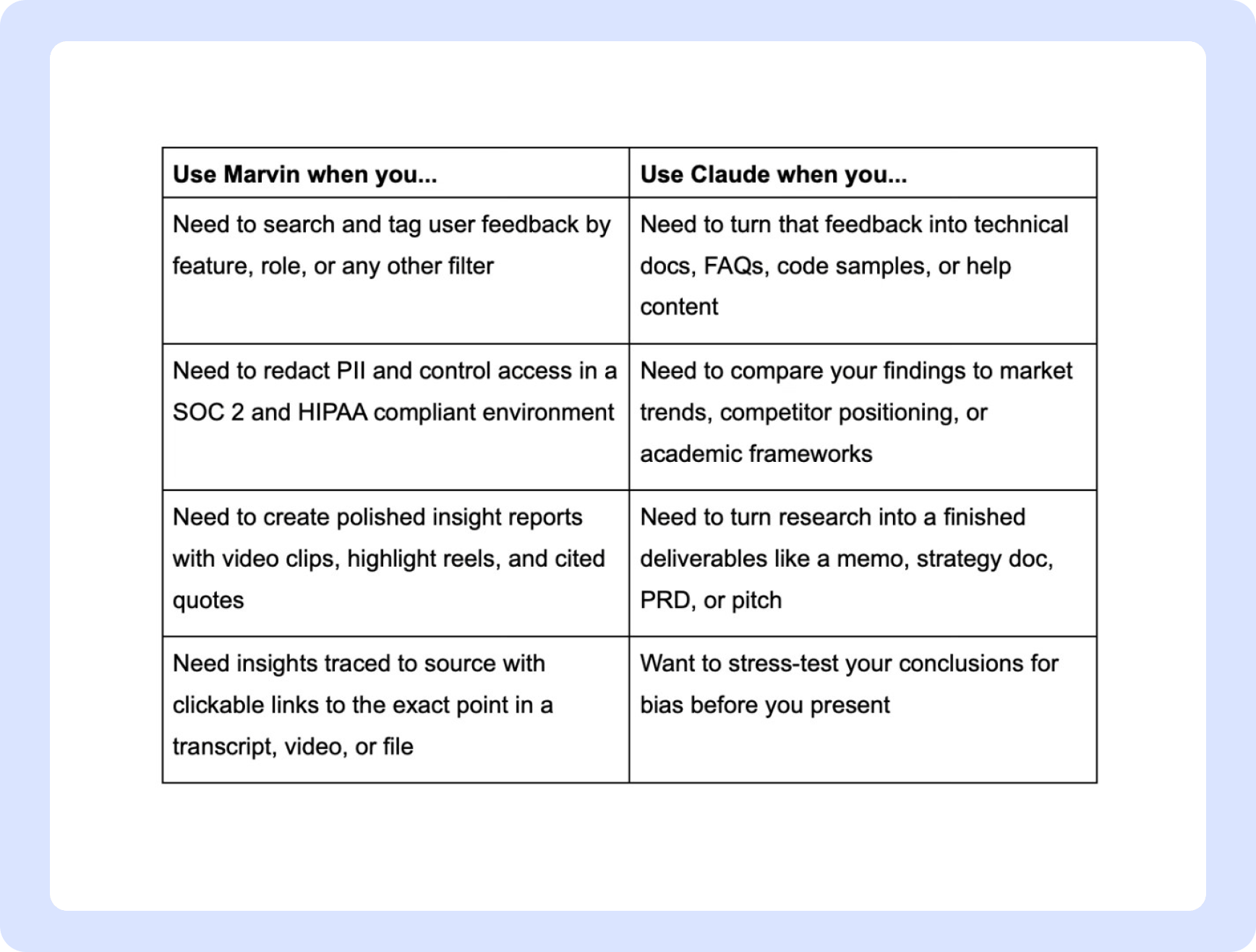
Marvin gives you customer truth you can trust. Claude helps you put it to work.
These are just a few of the workflows teams have built with Marvin and Claude connected. The best prompts come from experimenting with your own data. If you want help getting set up or want to see how a workflow looks with a live dataset, our team is happy to walk you through it. Reach out here.

See Marvin AI in action
Want to spend less time on logistics and more on strategy? Book a free, personalized demo now!