.png)
.svg)


AI Market Research Tools: Features, Benefits and 7 Top Picks
Discover top AI research tools, their features, and answers to common questions.



Solid research is the foundation of business growth.
While 62% of researchers say their company depends significantly on the insights they produce, teams still struggle to:
- Analyze large amounts of data
- Extract valuable, well-documented insights
- Continually turn raw information into actionable steps that support users and the business
AI market research tools can help you overcome these bottlenecks by automating basic processes. Read on to better understand your options and discover some of the best AI software for market research.

TL;DR - Best AI market research tools
Before we get into details, here’s a quick side-by-side comparison of the top 7 tools we review in this guide:
How AI powers modern market research tools
AI adds new functionalities to market research tools, so you can manage your team’s data effectively. Aside from automating data collection, AI helps you analyze all your data on a deeper level, at scale:
- Work with open-ended responses, transcripts, recordings, and other unstructured data much faster.
- Pull signals from different sources into a single view, making it easier to see where patterns overlap.
- Surface recurring themes automatically, before someone has had time to read through every response or tag every transcript by hand.
- Link insights to their original source material, which helps increase trust and implementation of customer insights.

Benefits of using AI tools for market research
AI market research tools provide strategic advantages like gathering insights faster, scaling data analysis, and enabling informed decision-making.
Here are the five benefits:
1. Accelerates data analysis
You can use AI to process volumes of data in seconds to extract meaningful insights in minutes (not days or weeks).
You can also explore complex research questions that could take human researchers weeks to solve.
2. Supports live data analysis
AI-powered solutions can analyze data in real-time to identify patterns in consumer behavior, competitor activity, or market shifts.
You can take a proactive approach to adapt the real-time insights into strategies that help you stay ahead of your competitors.
3. Saves costs Ccmpared to traditional research methods
Traditional market research requires labor-intensive, manual processes for data analysis. By automating data analysis, you can reduce these costs.
4. Minimizes human error
Manual data analysis is prone to human error and biased conclusions.
AI market research platforms free up your time and mindspace by analyzing vast data, improving accuracy, and increasing your productivity.
5. Automates repetitive tasks
Conventional market research methods were notoriously time-consuming. Processes like monitoring social media and analyzing surveys often took weeks or months. You can now accomplish those tasks in a fraction of the time.
Key features of AI market research tools
Although each tool offers unique features to support better insights, here are the top 10 features you should consider:
- Automated Data Collection: You can automatically gather data from diverse sources like social media, websites, surveys, and public databases, reducing errors found in the manual process.
- Sentiment Analysis: With AI tools, you can assess the customer emotions and tone around your brand and offerings, allowing you to tailor your products more effectively.
- Predictive Analytics: Using machine learning, you can forecast market trends, customer behavior, and product demand based on customer data patterns.
- Natural Language Processing (NLP): NLP allows AI market research tools to analyze qualitative data, such as customer reviews, social media comments, and open-ended survey responses. These tools can extract sentiment, themes, and opinions.
- Seamless Integration with Third-Party Platforms: You can connect your AI market research tool with other CRM and marketing tools to get a holistic view of your customer data.
- Data Analytics and Visualization: AI tools transform raw data into actionable insights. They also create dashboards, charts, and reports, making it easy for stakeholders to interpret the data.
- Automated Reporting: AI tools can auto-generate summaries and reports, saving you time by eliminating manual document generation.
- Audience Segmentation: You can use AI software to categorize your audience into groups based on their behaviors, preferences, and demographics. You can then tailor targeted marketing strategies for each segment.
- Real-Time Data Monitoring: AI platforms constantly assess data that streams in from various sources. They also provide insights to allow you to act quickly on market changes.
- Multilingual Capabilities: With these AI tools, you can analyze data in multiple languages, enabling global market research.

Top 7 market research tools compared
Some AI market research tools focus on collecting data, while others analyze it using qualitative, quantitative, or mixed-methods approaches. A few tools try to bring everything together in one system.
While reading the AI market research tool reviews below, consider which one completes your tech stack.
1. HeyMarvin
HeyMarvin’s customer insights platform helps teams manage large volumes of qualitative and quantitative data without splitting them across different workflows. Unlike other tools that layer AI on top of the workflow, HeyMarvin is AI-native. It uses AI to help collect data, analyze it, and find insights as you go.
Use HeyMarvin to bring interviews, surveys, and other inputs into one place and analyze them in real time. The system helps you tag, summarize, and connect data points, so you can surface patterns, organize insights, and make everything searchable. Moreover, it traces insights back to their sources, compares patterns throughout datasets, and builds on earlier research as new data comes in.
Long-term, HeyMarvin helps you make your entire body of research navigable and (re)usable.
Key features:
- AI-generated insights, including source references
- Automatic transcription and note-taking
- AI interviewer to conduct research sessions at scale
- Thematic analysis and pattern detection with human validation
- Centralized UX repository for qualitative and quantitative data
- Integrations with tools like Miro and Figma
Best for: Creating a single source of truth for all your market research insights
Book a free demo to see how HeyMarvin synthesizes and analyzes your data to support your entire market research workflow.
2. Maze
Maze is a user testing platform that supports usability tests, surveys, and prototype validation. It helps you test ideas and messaging, showing you how users respond to specific features.
With a robust set of AI features, Maze streamlines testing. It won’t help you connect findings from different studies, but it can quickly extract relevant insights from individual projects.
Key features:
- A solid panel that hosts participants from 130+ countries and offers you over 400 filters
- Support for prototype testing, card sorting, and tree testing
- Options to optimize questions for clarity
- Automatic summaries
- Theme detection
Best for: Quick user feedback for product or concept validation
3. Hotjar
Use Hotjar to see exactly how users behave on your website or in your product, and compare it to what users say in surveys or interviews.
This analytics tool will record user sessions, generate heatmaps, and use AI to extract valuable insights. With Hotjar, you can easily identify friction points and uncover the common thread in user journeys.
Key features:
- Session recordings you can replay as often as you need
- Attention heatmaps to see where users spend time
- User journey maps
- On-site surveys and feedback widgets
- AI-assisted analysis
Best for: Qualitative insights on user habits and product experience
4. SEMRush

SEMrush is a market intelligence platform. It focuses on external signals (search behavior, competitor activity, content performance, etc.) to help you understand what people are looking for in the larger market context.
AI helps analyze these signals. It reveals content and visibility gaps so you can address them quickly and easily without having to piece everything together yourself.
Key features:
- Tracks brand visibility in search and AI answers
- Shows which prompts surface competitors
- Keyword research and trend tracking
- Content and topic gap analysis
Best for: Acquiring insights on market demand, trends, and competitors’ activity
5. Qualtrics
Qualtrics is an experience management software that helps organizations run research at scale. It brings together survey data, customer feedback, and other experience signals, enabling you to track what’s happening at different touchpoints.
You can run large surveys, monitor trends, and use its built-in AI to gauge how customer sentiment and behavior evolve.
Key features:
- Advanced survey design and distribution at scale
- AI-powered text analytics for sentiment and theme detection
- Omnichannel data collection (surveys, digital, support interactions)
- Dashboards for tracking trends and experience metrics over time
- Automated analysis and suggestions based on incoming data
Best for: Running continuous research and tracking customer/market patterns over time
6. Brandwatch
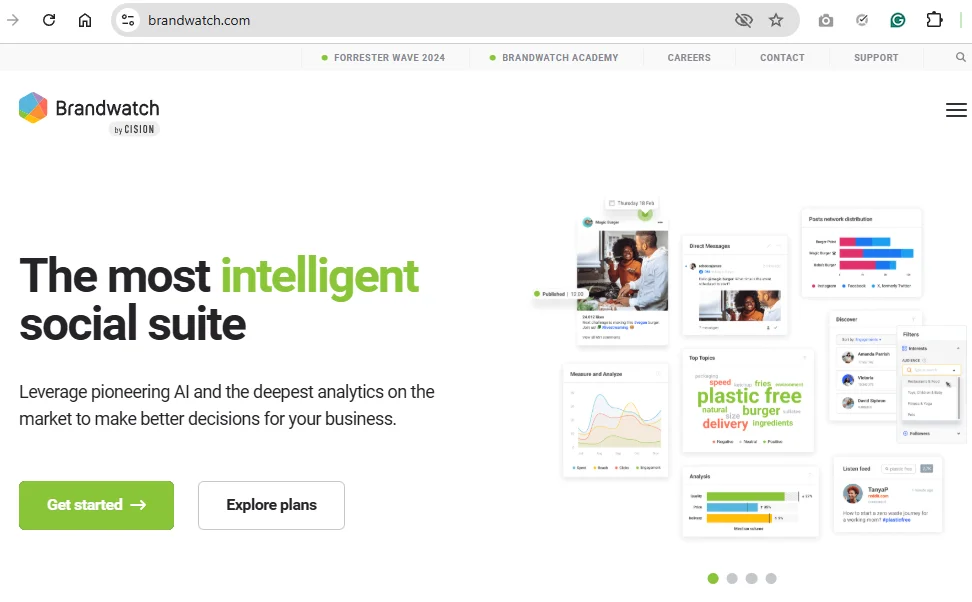
Brandwatch gives you access to large volumes of real-time and historical conversations from social media, forums, news, and other online sources. It’s particularly useful for spotting trends, tracking brand perception, and understanding how markets shift over time.
By analyzing how conversations naturally evolve across audiences and channels, Brandwatch helps you detect emerging themes early.
Key features:
- Audience analysis based on real-world conversations
- AI-powered sentiment analysis
- Trend detection
- Historical data access for long-term market analysis
- Custom dashboards and alerts
Best for: Real-time visibility into consumer sentiment and brand perception
7. GWI
While you monitor conversations online, GWI can show you profiles of the people behind them. This tool gives you access to large-scale consumer data from global markets.
Instead of running your own surveys or interviews, you use a dataset that GWI built from millions of respondents. The built-in AI features give you quick answers about your ideal audience and their behavior. Unlike other tools, GWI doesn’t focus on deep analysis of your own data, but it’s great for making decisions based on broad, reliable market signals.
Key features:
- AI-assisted insights that help you explore ideas and test hypotheses faster
- Audience segmentation based on demographics, behaviors, and attitudes
- Trend analysis built on regularly updated survey data
Best for: Quick, reliable audience insights that don’t require running research from scratch
How to choose an AI market research tool
Choosing the right AI market research tool requires a clear understanding of how your team works with data and what decisions you need to support. Your tools should help you collect more data and make sense of it all, whether it’s customer feedback, competitor activity, market trends, etc.
Here are a few measures to take before settling on the tool of your choice:
- Set goals. Align these with business objectives. What outcomes do you hope to achieve using the AI market research tool? What type of insights are you trying to generate?
- Evaluate. Examine the available tools and establish criteria to weigh the options. Here’s a starting point
- Budget: What is the company willing to spend on the new software?
- Timelines: Give yourself a deadline to implement the new market research tool. A phased rollout can help your teams get comfortable with it.
- Functionality: What role will the tool play? Is it helping you collect data, analyze it, or connect insights across sources?
- AI features: Since ChatGPT dropped, everyone’s eager to slap “AI” on their branding. Audit a tool’s AI features closely to make sure they work as advertised.
- Versatility: Can the tool support more than one type of research input?
- Integrations: Does the tool integrate seamlessly with the existing tool stack?
- User friendliness: Is the tool easy to use? Will ‘consumers of research’ pick it up easily?
- Scalability: Future-proof your choice. Ensure the tool grows with your research needs. Can you scale rapidly?
- Data privacy: Does the tool comply with local data protection laws? What encryption and data security measures does it have in place? Is user Personal Identifiable Information (PII) protected?
- Customer support: What happens when you get stuck? Is there a dedicated support team/process in place to assist you?
- Free trials: Most tools have ‘Freemium’ versions available. Leverage these before making a final decision.
- Review regularly. The work doesn’t stop after implementation:
- Create documentation to guide proper usage.
- Gather feedback from users to understand how they are using the tool.
- Set up training sessions for newbies.
- Evaluate the tool periodically to see if it's meeting business objectives.
Easy as 1-2-3!

Common challenges and how to avoid them
While AI market research tools are powerful, they present unique challenges that can lead to poor marketing strategies if not managed correctly.
- Human Bias in Data Collection: Researchers focus on data that confirms their existing beliefs.
How to Fix: Bring in diversity in your research team to encourage different perspectives in interpreting the data and making informed decisions.
- Over-Reliance on AI: AI-driven tools can process data efficiently, but they can miss critical nuances such as context and cultural factors.
How to Fix: You should have human oversight to add depth to the analysis and ensure accurate decision-making.
- Ethical and Legal Concerns: AI raises a lot of questions for market researchers to consider, including protecting the privacy and consent of your respondents.
How to Fix: You can follow ethical principles and data protection regulations such as GDPR and CCPA when using AI to collect and analyze data.
- Overwhelming Amount of Data: AI can generate a massive amount of insights from your research, making it challenging to identify actionable information.
How to Fix: You should set clear business goals and KPIs to prioritize the right insights.
- Difficulty in Integration: Some AI market research tools might not be easy to connect with existing marketing, CRM, and analytics platforms.
How to Fix: Choose an AI solution that integrates with your favorite tools and has API support.

Frequently asked questions (FAQs)
Here are some frequently asked questions about AI Research Tools:
How can AI tools assist in data collection and analysis for market research?
AI tools help collect and process large volumes of data from multiple sources, reducing the need for manual work. They can then analyze this data to identify patterns, connect insights across projects, and link findings back to their original sources.
Some tools also incorporate external signals (competitor activity, market trends, etc.) to give you a more complete market view.
How do AI market research tools help teams share and act on insights?
The best AI tools let you centralize research, set access permissions, and integrate with many different tools for easy sharing.
For instance, HeyMarvin can embed media into your favorite communication tools to share findings with co-workers across the organization. People don’t need a HeyMarvin account to view or reply to the insights you share.
How can researchers evaluate the accuracy of AI research tools?
The simplest way is to review the AI-generated insights and trace their source. Good AI market research tools automatically link to the original data, so you can validate whether they hold up.
What is the difference between AI tools for qualitative and quantitative market research?
Qualitative tools help identify themes, sentiment, and patterns throughout your interviews, open-ended survey responses, or recordings.
Quantitative tools work with structured, numerical data and use statistical methods to analyze survey results at scale, track trends, and test hypotheses.
Conclusion
AI market research tools help teams make sense of large datasets, cutting down a lot of the manual work that tends to slow things down.
While there isn’t a single tool that covers the entire market research process, some options come with a wider range of features than others.
Our AI-native customer insight platform, for instance, can help you review both qualitative and quantitative data in one place. Use HeyMarvin to go deep into your market research data, quickly spot patterns, and extract actionable insights.
Create your free account (no credit card required) and start extracting usable market-level insights from your research today.

See Marvin AI in action
Want to spend less time on logistics and more on strategy? Book a free, personalized demo now!

.png)