.png)
.svg)


How to Create a UX Research Plan in 6 Steps (with Example)
Master the essentials of UX research planning with a clear, six-step guide and practical example.



Conducting research without a UX research plan is like forging a sword blindfolded.
Pointless.
Poor jokes aside, research without a plan is a recipe for disaster. It eats away at resources, costing companies precious time and money. More importantly, it can cause you to move in the wrong direction. This puts a below-par product in the user’s hands that doesn’t address their needs.
With the complexity and scale of research studies, you’re missing a step if you don’t plan properly. So, we thought we’d address this with a comprehensive guide.
Here are our two cents on creating a UX research plan. Explore the benefits of creating a plan and how to create one from scratch.
Thank us later.

What is a UX research plan?
A UX research plan is a structured document that outlines individual research projects. A living document, it establishes clear goals and a defined scope of a study. It details various dimensions such as tactics, methodology, timelines, and resource constraints.
UX research plans serve as roadmaps — acting as a reference point and keeping teams on track.
Initially, plans establish the purpose of the study. This aligns stakeholders with the project goals. Throughout the research process, the plans focus everyone's attention on strategic objectives. Once research is complete, they answer key questions from the beginning of a project.
A well-crafted research plan is essential for conducting effective research.
Key benefits of developing a UX research plan
The right UX research plan defines and aggregates your research objectives and initiatives. It reduces the likelihood of overlooking important information and increases your work’s efficiency and accuracy.
Here are the main benefits of carefully planning UX research:
Defines the problem
Drafting a plan helps clarify the research problem:
What question are you trying to answer? What are the project goals? What do you want to accomplish?
Explicit questions help you shape specific, measurable goals to track and work toward.
Aligns stakeholders
UX research impacts multiple teams. A solid plan brings everyone’s questions into the study and aligns teams on research priorities.
Also, when you involve stakeholders in the UX research plans, they become more invested. Consequently, they will be more likely to act on the insights when it’s time to make an important business decision.
Optimizes workflow
A UX research plan is actionable. It clarifies everything from project goals and research methods to deliverables and timelines.
You can use it to set realistic expectations, streamline the research process, and make decisions at every step.
Saves resources
Planning UX research enables efficient allocation of time, money, and manpower. Plus, it helps identify potential roadblocks and issues early on.
As teams leverage the company’s existing research, they avoid silos and duplicative efforts. This minimizes development time and production costs.

How to choose the right UX research methods
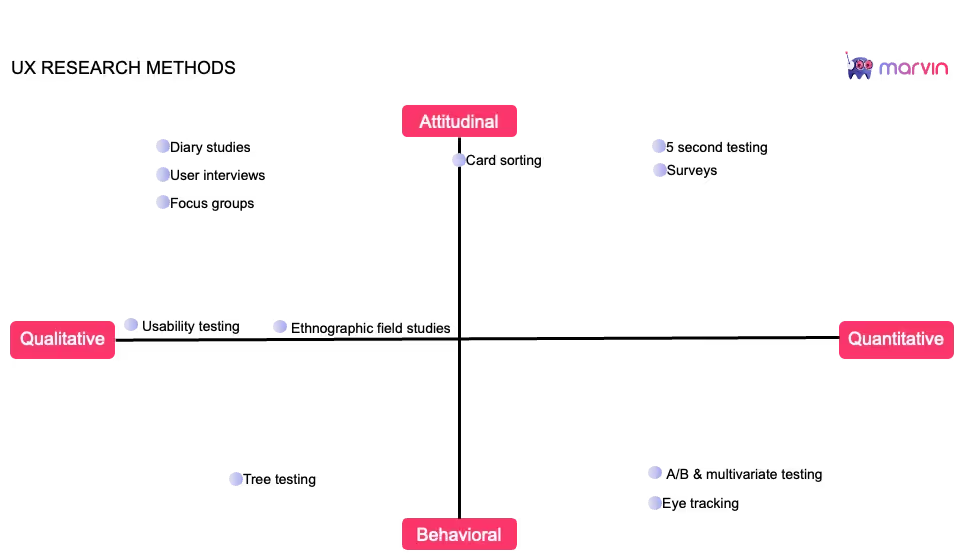
To understand more about their users, researchers collect two different types of data:
- Behavioral. Measures how users interact with and navigate through a product.
- Attitudinal. Understand how users feel and why (while they’re immersed in a product).
Data collected can either be qualitative or quantitative. Remember, combine qualitative and quantitative research to understand the context behind user actions. Learn when to use quantitative vs. qualitative research.
It’s essential to determine your needs before choosing the correct study methodology. Any research methods you choose depend on:
- Initial research question. What do you want to find out about your customers? Are you looking for feedback on a design? Or trying to understand user needs?
- Stage of product development. Generative studies such as interviews help collect deep user feedback. This helps while brainstorming new products. Testing a final prototype is more evaluative. Usability testing helps researchers identify bugs. Researchers examine how users navigate through an app.
- Product use context. Where and how is research conducted? Will you observe users in their own environment or a controlled one (lab)? Will they carry out specific tasks? Or regular use?
- Resource constraints. Establish the scope and budget of the study. Is it a small or large-scale study? What resources will you need? What tools can you use (free or paid)?
- Timelines. How much time can you afford for research efforts? When do you need certain deliverables?
Use the graphic below to identify the method that best suits your study:
How to create a UX research plan
UX research plans must answer a study's who, what, when, why, and how.
Follow our 6-step process to create a strong user experience research plan:
Step 1: Define research purpose and goals
First, establish WHAT challenges you’re trying to solve.
What is the end goal? What decision-making will this research inform?
A clear scope of work, with objectives and deliverables, ensures focused effort and prevents confusion later on.
Remember, research must benefit your users and your business. Therefore, align research objectives with broader business goals.
Step 2: Gather stakeholder requirements
Stakeholders benefit from your research. Considering their requirements will give you valuable insights to translate research objectives into business goals.
Brainstorm with people from product, design, development, sales, and customer success. Understand their questions and pain points. And prioritize needs while accounting for your project’s constraints.
Step 3: Identify the research participants
Next, focus on WHO you’ll be learning from. What type of participants will you recruit? And what characteristics are you looking for?
To ensure diversity and inclusivity in your research group, select participants based on:
- Demographics
- Psychographics
- Habits
- Behaviors
Decide how you will recruit, screen, and compensate these people. Avoid limited results by recruiting from multiple sources. Start with existing customers, but also consider recruitment platforms.
Step 4: Choose a research method
HOW will you answer your research questions? Will you collect quantitative, qualitative, or a mix of data?
Use the diagram above to choose the right research methodology. Include a brief that details your reason for choosing a particular method.
Then, select your tools based on available resources and budget. Choose software that best suits your research needs today and tomorrow.
Speaking of tools, why not give HeyMarvin a spin? This research platform houses all your quantitative and qualitative data, helping you analyze and understand the user experience.
Step 5: Establish timelines and allocate resources
WHEN will you execute your research study?
Timelines depend on the complexity of the process and should account for:
- Finances: How much money is available? What tools will you need?
- Manpower: How many team members will work on the research?
Consider the time required to plan the study, recruit participants, collect and analyze data. Create a schedule and set deadlines for project deliverables.
For every role involved, assign tasks and outline a detailed study protocol and logistics. Include action plans to decide the next steps.
Step 6: Determine how to analyze and present research findings
Finally, decide how you will analyze the data and share the results.
Outline the following:
- Methods for reviewing the findings (thematic analysis for interviews, usability metrics such as task success rates, survey statistics).
- Communication across the organization to meet the needs of different stakeholders (usability clips, journey maps, summaries tied to product decisions).
- Deliverables you need to produce (reports, presentations, repository of tagged insights, highlight reel of user quotes).
Listing all these in advance helps you interpret the findings later and gives stakeholders useful context for the results.

Where AI changes the UX research planning process
In practice, AI does not replace research planning. You still define the problem and shape the study.
But here’s how it enhances the process:
Gives you more speed
Research planning often begins with scattered inputs. Stakeholder questions, support tickets, product feedback, and analytics all point to potential problems. Sorting through this information manually can take hours or days.
AI helps you move faster by scanning large amounts of input and grouping them into themes. This gives you a clearer starting point when defining research goals and questions.
Surfaces existing insights
Before planning a new study, it helps to check what the team already knows.
AI can search across past interviews, usability tests, and survey responses to surface related insights. Instead of digging through recordings or reports manually, you can quickly see whether your colleagues explored similar questions.
Using AI helps you avoid duplicating research and enables you to refine your study based on existing findings.
Assists with drafting the actual plan
Once your research questions are clear, AI can help draft parts of the research plan.
Based on your goals, it can suggest suitable research methods, interview prompts, or usability testing tasks. For example, if you want to understand why users abandon a checkout flow, AI may recommend usability testing to observe behavior and short interviews to explore expectations.
Using AI spares you the work of building the plan’s structure from scratch. You can start with a first draft and bounce questions to the AI assistant as you review and refine the plan.
Using HeyMarvin as a UX research plan tool
If you want to speed up research planning without losing rigor, HeyMarvin can help. Use it to pull together past interviews, surveys, support tickets, and other feedback into one searchable place, so you do not have to plan a study without prior knowledge.
Its AI features can also support the planning work itself. Use HeyMarvin to spot themes in existing data, surface evidence tied to your research question, and identify what still needs to be explored. That makes it easier to define study goals, choose methods, and shape a smarter discussion guide.
Because HeyMarvin links insights back to source evidence, it also helps you build research plans on top of what your team already knows, not just what it remembers. That means less duplicate work, faster planning, and a stronger path from research question to study design.
Create a free Marvin account today to streamline your UX research.

UX research plan example
A good UX research plan must include the following:
- Title. Name your project so people across the organization can easily identify it.
- Date. When did the project begin?
- Author(s). Who’s in charge of the project? This may be multiple people. Include their contact information so readers can get in touch.
- Stakeholder Information. Which stakeholders need consulting? Include a point of contact from different teams to understand and establish their needs.
- Project Background. Akin to an executive summary, this section includes two to three sentences on why the project is being conducted.
- Project Goal. Sums up the objective of the project in one sentence. Define metrics to measure success.
- Research Question(s). What questions will the research answer? Listing them down helps identify data collection and analysis methods.
- Research Methods. Which research methods will you use? Use our diagram above to determine which methodology suits the study best.
- Participant Information. Define the target audience for your study. Include the sample size along with demographic and psychographic information.
- Risks & Assumptions. What assumptions have you made during research? What are the inherent risks? List them all out. Be exhaustive.
- Deliverables. Establish deadlines for key deliverables. Add milestones to track project progress.
- Timelines. When does the project start and end? Estimate how long each part of the study will take.
- Budget. How much money is available for the study? Estimate overall costs to prioritize activities.
Feeling overwhelmed? Don’t know where to begin? Marvin’s here to help!

UX research plan template
Here’s a UX research plan template to get you started.
<figure class="wp-block-table"><table><tbody><tr><td><strong>#</strong></td><td class="has-text-align-left" data-align="left"><strong>Section</strong></td><td><strong>Description</strong></td></tr><tr><td>1</td><td class="has-text-align-left" data-align="left">Title & Date</td><td>Project Mamba; 08-08-2024</td></tr><tr><td>2</td><td class="has-text-align-left" data-align="left">Author(s)</td><td>David Brent; dbrent@whogg.com</td></tr><tr><td>3</td><td class="has-text-align-left" data-align="left">Stakeholder Info</td><td>Design / Product – Jonny Five; jonny@whogg.comEngineering – Elon Husk; elon@whogg.comSales – Sara Newman; sara@whogg.comCustomer Success – Dwight Shoot; dwight@whogg.com</td></tr><tr><td>4</td><td class="has-text-align-left" data-align="left">Project Background</td><td>WHogg, the regional UK paper distributor, wants to digitize its sales process. They recently launched a website for B2B customers. After an initial flurry of activity, they found that few people complete transactions online. Instead, they revert back to calling a sales representative.<br/>WHogg would like to understand the root cause.</td></tr><tr><td>5</td><td class="has-text-align-left" data-align="left">Project Goal</td><td>To understand why users are dropping off before making a purchase.Success MetricsTime on Task (lower = better)Task completion rate %Conversions</td></tr><tr><td>6</td><td class="has-text-align-left" data-align="left">Research Question(s) / Script</td><td>What is the user journey like?What motivates people to use our product?Why do users leave the app?At what stage of the funnel do they abandon ship?What are user pain points?How do users feel while navigating through the app?</td></tr><tr><td>7</td><td class="has-text-align-left" data-align="left">Research Method(s)</td><td>Usability Testing – Session Recordings (30 min)Surveys (20 questions; unlimited time)Interviews (30 min interviews w/ customers)</td></tr><tr><td>8</td><td class="has-text-align-left" data-align="left">Participant Info</td><td>DemographicAge = 25-34 yearsGender = M/F/OLocation = Slough, EnglandOccupation = Procurement ExecutivePsychographicPrice sensitiveOrders periodically<br/>Sample Size: 20 people</td></tr><tr><td>9</td><td class="has-text-align-left" data-align="left">Risks & Assumptions</td><td>AssumptionsEach user is an existing customerUsers prefer a digital solution for buying paper<br/>RisksPoor participant response rateData cleanup</td></tr><tr><td>10</td><td class="has-text-align-left" data-align="left">Deliverables</td><td>User Journey MappingSurvey Results AnalysisSession Recordings ConclusionsInterview Insights</td></tr><tr><td>11</td><td class="has-text-align-left" data-align="left">Timelines</td><td>Week 1: Create and distribute surveys. Week 2: Draft a discussion guide for interviews. Create usability tests for recording. Week 3: Conduct interviews. Conduct in-person lab sessions. Week 4: Collect user data for analysis. </td></tr><tr><td>12</td><td class="has-text-align-left" data-align="left">Budget</td><td>$1,000</td></tr></tbody></table></figure>
NOTE: Remember to replace this fictional information with actual data!
Best practices for conducting effective UX research
Effective UX research ensures that products address user needs. Leveraging the research, designers and developers can create easy and delightful-to-use products.
Employ these best practices to get the most out of your research plan (and therefore research):
- Maintain a user-centric focus. To truly understand your customers, you must develop user empathy. It’s critical for designing products that they love using. Identify various user groups and personas - consult experts and naive users. What are their goals?
- Data-driven decision making. Don’t rely on gut feel - harness the power of user research to inform product decisions. Use a variety of methods and tools to collect quantitative and qualitative data. Paint a well-rounded picture of the user experience.
- Use soft launches. Pilot studies and interviews on a smaller scale to understand how they work. An important way to get feedback about your research process and make improvements or eradicate bias.
- Stay adaptable. Don’t set and then forget. Research is an ongoing practice. Continually iterate your research process. Gain better customer insights over time to refine the user experience.
- Communicate! How do you translate user needs into product choices that stakeholders understand? UX industry experts stress the importance of learning the language of business.
Make sure research applications quickly disseminate information on communication tools like Slack. Broadcast your findings across the organization with Marvin. Learn more about Marvin’s integrations.
Common UX research planning mistakes
No research study is straightforward. It’s a complex craft, requiring you to adapt to twists and turns along the way.
Avoid these common pitfalls when planning your UX research:
- Focusing on features, not outcomes. This is the opposite of user-centricity. When researchers become enthralled with adding new features, they lose sight of what the user really needs. What problems do these new features solve?
- Not setting specific goals. It’s not enough to say you want to understand more about your users. Being vague in your objectives leads to inaccurate and unusable results. Identify specifically what you’re after. Be clear in your questioning to get the right answers that inform business strategy.
- Failure to deal with bias. Every study has bias. Leading questions or confirmation bias can skew data and results. Testing research processes helps identify and mitigate bias. It’s important to acknowledge and document any inherent biases in your approach.
- Minimal stakeholder involvement. Failing to include stakeholders in research leads to poor buy-in. Without being actively involved, they can’t contribute their questions and insights to the process. Stakeholders are a great source of user information. Moreover, they have requirements from user research that need addressing.
- Ignoring context. Researchers can over rely on quantitative data. As a result, they ignore valuable qualitative information about the user experience. Collect qualitative data to understand user preferences better. Test in natural environments to collect real-world data.
Commit any of these research faux pas, and the product suffers. And we haven’t even mentioned the poor end users.

Frequently Asked Questions (FAQs)
Let’s address any lingering questions you may have about research plans:
Can I use a tool to develop an effective UX research plan?
You merely need an editable document that facilitates collaboration among stakeholders. We recommend that smaller teams begin with Google Docs or similar platforms to keep everyone on the same page with research initiatives.
Also, if you need an advanced tool, HeyMarvin can create helpful discussion guides and comprehensive interactive documents with video, audio, and text.
How do you manage and record data during UX research?
A research repository is the best choice to house UX research data. Some platforms require you to manually upload files.
Others automatically collect data from multiple sources and even transcribe your qualitative research (audio calls, video interviews, etc.) in real-time.
How do you integrate UX research insights into design?
- Collaborate with design and product teams. Discuss how to reflect research in design work.
- Translate insights into practical and actionable ones. e.g., “Users spend way too long trying to enter their personal information. How do we improve time on task?”
- Implement design changes.
- Test & iterate.
What is the right sample size for a UX research plan?
In your plan, specify how many participants you intend to recruit, based on the research method and goals.
With qualitative usability testing or interviews, 5 to 8 users should help you identify most issues. If you’re looking for reliable, statistically significant quantitative data, you’ll need at least 30 users.
What is the difference between a UX research plan and a usability test plan?
A UX research plan outlines the overall strategy for a research study.
In contrast, a usability test plan is more specific. It focuses only on how you will run a usability test (user tasks, testing environment, key metrics).
Conclusion
Planning is an essential first step of the UX research process.
UX research plans give research a purpose and direction — they clarify the goals of a study.
Plans facilitate the gathering of stakeholder requirements and inputs. Clearly outlining goals and objectives, they keep everyone aligned. In the long run, research plans save the company plenty of resources (money, manpower, and time).
They define problems and help generate actionable insights that inform product decisions. By integrating insights into design, companies create products that resonate with their users.
The importance of planning research isn’t lost on us. If you’re reading this far down, you’re likely in the same boat.
Happy planning!

See Marvin AI in action
Want to spend less time on logistics and more on strategy? Book a free, personalized demo now!