.png)
.svg)




When you look at the strides Marvin took in 2025, last year feels a galaxy away.
We made this leap forward by doubling down on our core principle: the best teams listen to their users. They let feedback, not assumptions, guide their decisions.
It’s the same belief that shapes how we build Marvin.
Every product enhancement we shipped this year came from listening closely to you. So, let’s rewind and look at what we built together.

Redefining the research repository
For a long time, user research followed a familiar rhythm:
A question came up. A study was planned. Interviews were run. Insights were shared. Then everything went quiet again until the next moment of urgency.
But AI disrupted that rhythm. Now that everyone can build faster, design has become the competitive differentiator. Teams rely more heavily on customer understanding to create a strong brand, product design, and user experience.
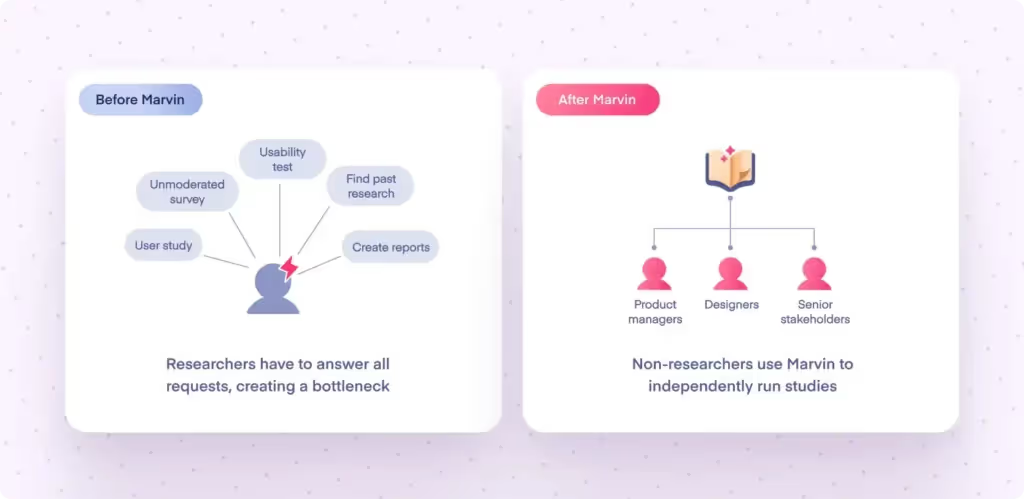
Tools like Marvin have opened the door for product, design, sales, customer success, and marketing to do research. When access is democratized, you need an active system. One that listens constantly, organizes automatically, and makes insights accessible everywhere.
Instead of asking, “How can Marvin be a better research repository?”, we started asking, “What would it take for Marvin to become a unified, living system of customer knowledge?”
Data collection: The year you captured more feedback than ever
To power your knowledge engine, we made sure every piece of user feedback could flow naturally into Marvin.

AI Moderated Interviewer: More interviews, no scheduling limits
One of our most significant launches of 2025 completely revamped how user interviews are conducted.
Teams used Marvin’s AI Moderated Interviewer to run interviews across languages, time zones, and user segments they previously couldn’t reach. Customers didn’t have to choose between speed and rigor. They could gather high-quality feedback even when no one was available to moderate interviews. They set up highly customized user studies with AI Moderated Interviewer in minutes instead of days. One of our healthcare customers highlighted how they 4x’d research output with Marvin.
Discussion guides that build trust and maintain consistency
ResearchOps teams told us they needed clearer guardrails and more consistency in every study. They wanted both researchers and non-researchers to have access to reliable discussion guides.
To support that need, Marvin’s AI now generates discussion guides based on project goals and files. Teams use these drafts as the base for their questions and notes.
Users can also upload existing discussion guides their team already trusts. This helps ResearchOps keep every team aligned on the same standards.
Integrations that make Marvin the connective layer for customer knowledge
Every new Marvin integration in 2025 started as a customer request and pushed us closer to one goal: make all customer research and data flow into one central, searchable hub. Marvin’s qualitative research workflows help organize, contextualize, combine, analyze, and transform the data into insights.
Teams can now sync Microsoft SharePoint, Microsoft OneDrive, and Microsoft Forms so all documents and responses flow into a central knowledge hub.
Our Maze and Dscout integrations added capabilities for teams to bring in unmoderated research. They can analyze card sort results and responses in Maze usability tests at scale. We enhanced our Dscout integration to support diary studies and media surveys, in addition to usability tests. Teams have complete context with access to screen and participant recordings for all types of studies.
With our Salesforce and Rally integrations, you can enrich research panel data to learn about user cohorts. All our data collection enhancements led to your teams uploading hundreds of thousands of interviews, support tickets, unmoderated research, reports, and sales calls into Marvin in 2025.
Data management and governance: Making it easier to maintain and understand data
As more data flowed into Marvin, we invested in features to help you keep data organized, compliant, and easy to understand.
Data retention: Research-grade privacy and compliance
Marvin now helps admins track how long every file and project has lived in your workspace. With automatic deletion, they can remove projects or files after defined retention periods. Teams stay compliant with data storage laws more easily than ever.
This keeps your knowledge engines organized, reduces risk, and eliminates a tedious manual task from ResearchOps.
Project updates: Catch up on projects at a glance
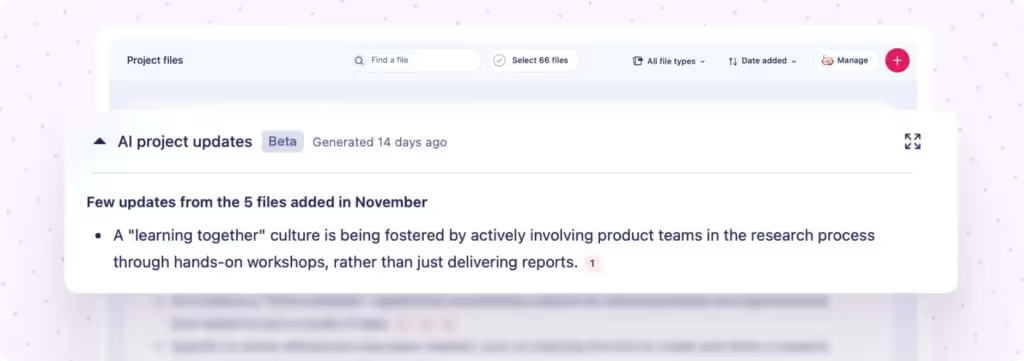
We wanted project collaboration to feel simpler, so we’re soon introducing running summaries for all projects. Each time a new file is added, Marvin will automatically create a new summary. Stakeholders can track progress and spot emerging trends without asking for updates.Call summaries, tailored by role.
Call summaries, tailored by role
One size never fit all, so we changed our approach.
Marvin can customize call summaries depending on whether you’re in research, product, design, customer success, or sales. Each team sees the insights that matter most to their work.
More relevant context helps everyone leverage data better for their goals.
Analysis: From answers to insights at unprecedented scale
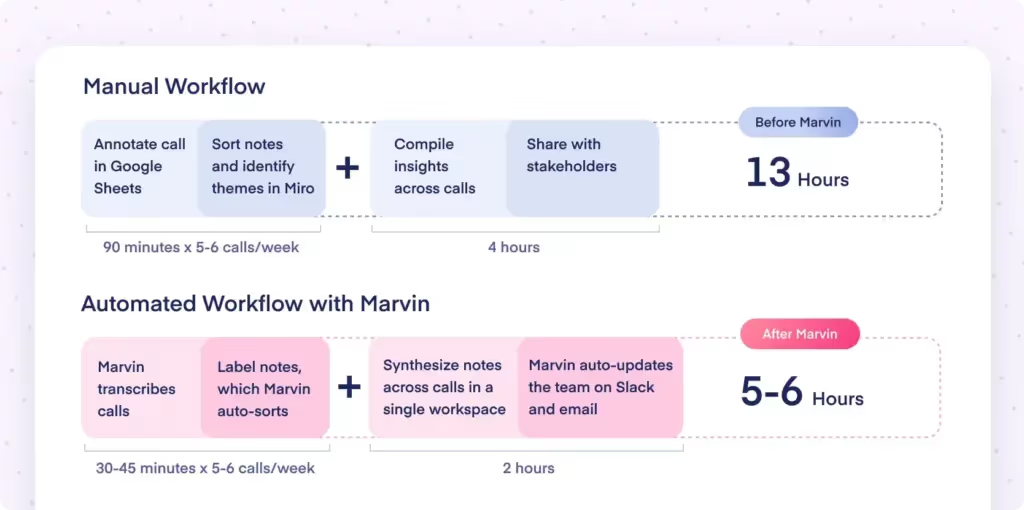
As you captured more feedback this year, we focused on making analysis deeper and more connected across projects. Teams used these features to reduce time to insight by 50%.
Agentic Ask AI: In-depth answers to your questions
In 2025, we enhanced our most-loved feature to go deeper and think harder. Our soon-to-be-launched Agentic Ask AI spends more time drawing out nuanced answers to your queries.
Marvin identifies and analyzes supporting evidence from across your knowledge engine. It then uses a new iterative thinking process to reach detailed answers.
Users will soon have access to:
- Richer contextual answers
- Clearer traceability to source data
- Stronger multi-source synthesis
Deep Research
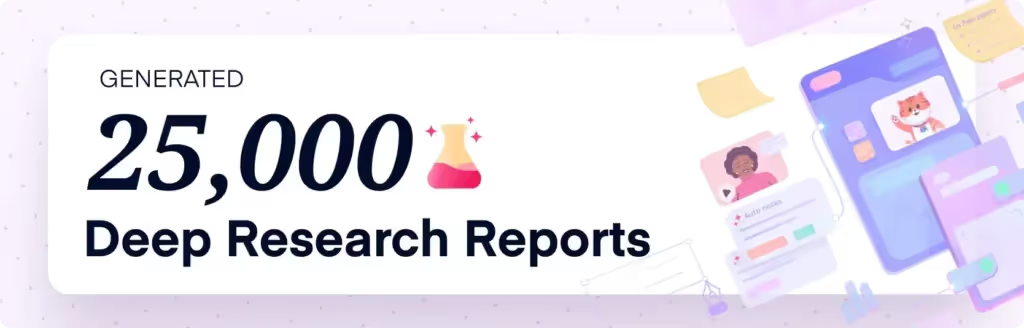
Deep Research gives you the depth and rigor of an experienced researcher with the speed of AI. Our prompts help everyone create expert-level reports from raw data.
This year, we added new prompts based on the most common use cases.
Asking questions you didn’t plan for
Instead of being limited to your discussion guide, teams can now ask broader questions. Marvin scans all project data to generate structured, side-by-side Q&A tables.
Patterns emerge instantly. Contradictions surface. Gaps become obvious.
Extracting Jobs-to-be-Done
Teams were spending hours analyzing interviews to identify users’ jobs. We developed a custom prompt to reduce the time to insight. Teams can go from call transcripts to detailed Jobs-to-be-Done analysis in minutes.
Marvin highlights triggers, desired outcomes, pain points, constraints, and success criteria.
Auto-labeling at scale
With millions of notes flowing into Marvin, manual tagging didn’t scale.
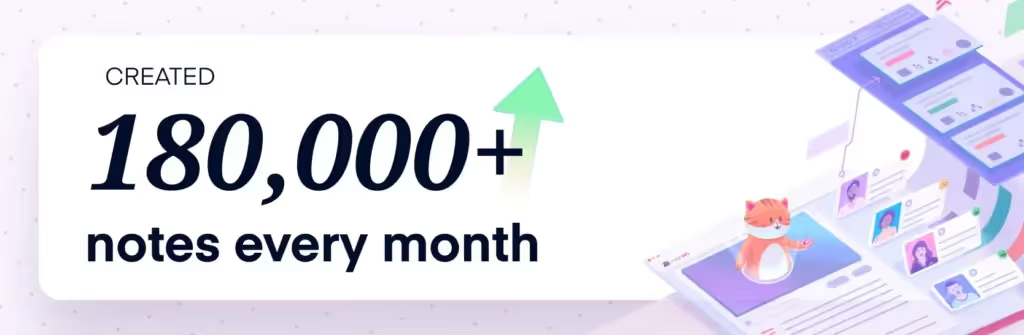
So we launched Auto-labeling to match thousands of notes to relevant labels in one go. Teams no longer spend time painstakingly labeling each note. Instead, they can review, revise, and label in bulk.
Some teams would take weeks to label support tickets that flow into Marvin. They now turn it around in less than 2 hours, and spend the time saved on spotting patterns in those tickets.
Projects with multiple researchers have also benefited from more consistent labeling.
Analyze tab upgrades: table view
We added a table view to the Analyze tab that makes it easier to:
- Sort and filter notes
- Compare insights across users
- Edit metadata in place
With more ways to go deep into the data quickly, users in every role can explore patterns with far less friction.
Affinity mapping, reimagined
Affinity mapping finally caught up with how teams actually work.
Teams can now combine manual analysis with AI-assisted mapping, and affinity map thousands of notes. Using labels as themes gives every board a head start, so teams move from raw notes to structured insight much faster.
Using AI to find relevant notes for each theme makes the process more efficient and effective.
Insight generation & sharing: Generating a continuous stream of insights
One of Marvin’s biggest wins this year was enabling seamless, continuous insight sharing. Automated updates freed researchers from searching for insights on behalf of others or reminding teams to engage with research.
Automated sharing to Slack
We saw how teams amplified the visibility of their research with our Slack integration. So, we enhanced it to push tailored updates from each project to specific channels. This ensures you reach the right audience every time, without manually copying and sending messages.
Teammates can play clips and use /heymarvin to access Ask AI without leaving Slack. Research no longer stays confined to Marvin. Everyone can surface insights in their daily tools, exactly when they need them.
Salesforce integration: Full customer context
Our two-way Salesforce integration helps sales and product teams align more deeply. Product teams learn more about cohorts when they can enrich Research Panel data with customer history from Salesforce.
Sales teams gain user context when Marvin automatically adds summaries of all user interactions to Salesforce contact records.
AI Writer for research reports
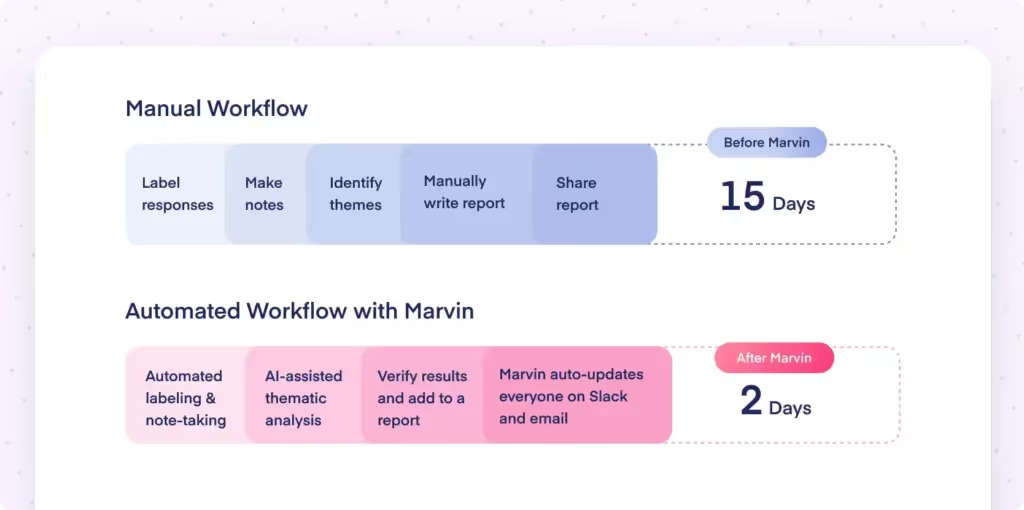
The hardest part of reporting is often just getting the words right. We added an AI Writer to the Insights workspaces to help teams transform raw findings into clear, stakeholder-ready narratives. By reducing the time spent on refining tone and language, users created reports faster. Less time editing means more time driving decisions.
Some users turned around reports for the entire month in 2 days instead of 15 days.
AI presentations of reports
This feature is in beta, and built with visual learners in mind.
Marvin will generate audio and slide summaries for every published Insight. You can listen or watch a summary while you work in Marvin.
To help fit research into daily workflows, we made insights easy to share and fun to digest.
The story of 2025: customer intelligence became continuous
Every update we shipped this year traced back to the same idea:
The need for research doesn’t arrive neatly at the start of a project. It shows up mid-sprint. During a renewal call. After a launch. When someone asks, “Have we heard this before?”
User insights shouldn’t depend on perfect timing, dedicated bandwidth, or specialized roles.
We focused on turning Marvin into a knowledge engine that moves at the speed of development. One that listens continuously, synthesizes automatically, and delivers insight where decisions are made.
Here’s what that unlocks:
- Customer success teams track feature requests over time
- Sales teams communicate closely with product using real-time information sharing
- Support teams spot trends in tickets and solve for a larger pool of customers
- Product teams collect and analyze user feedback in one place
- Marketing teams ground personas in real customer language
- ResearchOps teams ensure consistency and governance at scale
Thank you for the feedback, the feature requests, the opinions and the trust. You shaped our most transformative year yet.

See Marvin AI in action
Want to spend less time on logistics and more on strategy? Book a free, personalized demo now!

.png)
.png)